
Tractatus Logico-Philosophicus → http://people.umass.edu/klement/tlp/tlp.pdf
Foreword.
Abstract.
A. – Wittgenstein’s ”fundamental thought” (4.0312).
B. – Starting point of (4.0312) / Preface of Tractatus.
C. – Why Wittgenstein’s aim (is what it is)?
D. – Wittgenstein’s aim entail some theory of ”truth”.
E. – Correspondence theory dictate essential concepts and terms of Tractatus.
Symmary.
Appendix.
References.
– – –
Foreword.
Underlines and boldings of the paragraphs, as I call the sentences of Tractatus, are all mine. If italics is mine I say it. When I quote paragraphs, often I do not represent them in their entirety. Sometimes also certain parts of various paragraphs are compound. Of course I say it, for instance (4.001 + 4.06 + 5.47). Asterisk in the context of paragraphs tells that there’s a special link between paragraphs. I use diagonal / to a certain function inside some paragraphs. You can see an example right away below in part A..
Few words for the struckture of this presentation. I begin with facts, which seems to me evident, un-deniable. These things are not as much an interpretation, but straightforward, literal and comparative reading of Tractatus. These evident facts are good basis for interpretation. To rest on these undeniable facts it’s then anything but to go on. Step by step with literal and comparative reading of paragraphs of the book. First two parts of the paper present the evident things, facts. If the first part can be seen as a (negative) result of Wittgenstein’s aim it is a nice starting point; what goes around comes around.
This is going to be quite thorough, with many footnotes. Some of them particularly notable. Where I yield is of saying all relevant paragraphs in print. Maybe I could have abstracted more (and less recur-sions). Anyway there are in my interpretation many aspects, but same goal.
Abstract.
The logic of well ordered propositions of correspondence theory ”.. cannot be represented” (4.0312 , 4.128 , 6.4321). There is no general method or algorithm to deduce ”.. beforehand .. on one occasion .. totality of .. pictures of the reality” (4.001 + 4.06 + 5.47), totality of consistent propositions of corres-pondence theory that can be proved true or false. Ludwig Wittgenstein manifests in Tractatus logico-philosophicus negative answer to Entscheidungsproblem. He anticipates Alan Turing’s result from the year 1936. Not to mention Kurt Gödel, his theorem’s from the year 1931. – Wittgenstein’s picture theo-ry of language is premised on the logic* of correspondence theory (1.1 , 1.11 , 1.12* , 2 , 2.021 , 2.024*1 , 2.06 , 2.063 , 2.21 , 2.221 , 2.222 , 2.223 , 3.203 , 3.3 , 4.031 , 4.061* , 4.064). – First Wittgenstein makes well ordered propositions of said truth-theory (2.06 , 2.1 , 2.141 , 3 , 3.12 + 3.14 , 4 , 4.06 , 4.1 , 4.21 , 4.25 , 5 , 5.01). Then he asks, the aim of the book (Preface, (4.112 , 4.114)), can those propositions be said, enu-merated. The answer is negative (1.13 , 2.021 , 2.06 , 2.1 , 2.141 , 2.16 , 2.17 , 2.18 , 3 , 3.12 + 3.14 , 3.203 , 3.3 , 4 , 4.0312 , 4.06 , 4.1 , 4.12 , 4.121 , 4.12122 , 4.128 , 4.21 , 4.25 , 5 , 5.01 , 5.55 , 5.5571 , 5.61 , 6.4321 , 6.443 , 6.522 , 7).
A. – Wittgenstein’s ”fundamental thought” (4.0312).
”The possibility of propositions is based upon the principle of the representation of objects by signs. My fundamental thought is that the ”logical constants” do not represent. That the logic of facts cannot be represented”. (4.0312)
”.. Mein Grundgedanke ist, dass .. sich die L o g i k der Tatsachen nicht vertreten lässt”. (4.0312)
I decode Wittgenstein’s ”fundamental thought” in the following way – ”.. My fundamental thought is that .. the logic of / well ordered propositions that can be proved true or false / cannot be represen-ted”. (1.13 , 2.141 , 3.12 + 3.14 , 4.06 → (4.0312 , 4.128 , 6.4321))
Instead of saying ”facts” I say ”well ordered propositions that can be proved true or false”. This reading of paragraph 4.0312 makes sense throughout paragraphs (1.1 , 1.13 , 2.06 , 2.063 , 2.1 , 2.141 , 3.12 + 3.14 , 4.01 , 4.06 , 4.1 , 4.21 , 4.25 , 5 , 5.01). – Especially, quite directly with paragraphs 1.13 , 2.141 , 3.12 + 3.14 , 4.06.4
”The world is the totality of facts, not of things”. (1.15 , 1.13 , 2.06 , 2.063 , 2.1 , 2.141 , 3.12 + 3.14 , 4.01 , 4.06 , 4.1 , 4.21 , 4.25 , 5 , 5.01)
”The facts in logical space are the world”. (.1 , 1.13 , 2.06 , 2.063 , 2.1 , 2.141 , 3.12 + 3.14 , 4.01 , 4.06 , 4.1 , 4.21 , 4.25 , 5 , 5.01, italics is mine.)
As for ”.. logical space ..” (1.13) it is a space of the logic of correspondence theory (2.21 , 2.221 , 2.222 , 2.223 , 4.031); the theory of ”truth” to make well ordered propositions (2.06 , 2.1 , 4.06).
”The existence and non-existence of states of affairs is reality. (We call the existence of states of affairs a positive fact a positive fact, and their non-existence a negative fact.)”. (1.1 , 1.13 , 2.06 , 2.063 , 2.1 , 2.141 , 3.12 + 3.14 , 4.01 , 4.06 , 4.1 , 4.21 , 4.25 , 5 , 5.01)
”The total reality is the world”. (1.1 , 1.13 , 2.06 , 2.063 , 2.1 , 2.141 , 3.12 + 3.14 , 4.01 , 4.06 , 4.1 , 4.21 , 4.25 , 5 , 5.01)
Wittgenstein repeats paragraph 1.1. – ”The world is the totality of facts ..”. (1.1 , 2.063). To put paragraphs 1.1 and 2.06 together the result is:
”The world is the totality of .. positive .. and .. negative .. facts ..” (1.1 + 2.06).
As for ”.. positive .. and .. negative .. facts ..” (1.1 + 2.06) it’s reasonable to interpret that ”a positive fact” is of form ”it is true that things are in this way” and ”a negative fact” is of form ”it is true that things are not in this way”. To phrase these forms previous form is a true positive proposition like ”the earth is round in shape” and latter form is a true negative proposition like ”the moon is not a planet”, i. e. a false posi-tive proposition ”the moon is a planet).
That is to say Wittgenstein determines reality as a totality of true positive and true negative propositions, i.e. as a totality of true and false positive propositions.
Wittgenstein’s picture theory of language (2.12 , 4.01 , 4.06) necessitates to define reality6. Else there cannot be any conception of what ”.. pictures of the reality” (4.06) are.
”We make to ourselves pictures of facts”. (1.1 , 1.13 , 2.06 , 2.063 , 2.1 , 2.141 , 3.12 + 3.14 , 4.01 , 4.06 , 4.1 , 4.21 , 4.25 , 5 , 5.01)
”We make to ourselves pictures of .. positive .. and .. negative .. facts ..” (1.1 + 2.06 + 2.1).
If we combine paragraphs (1.1 , 2.06 , 2.063 , 2.141 , 3.12 + 3.14 , 4.01 , 4.06) it makes sense to decode pa-ragraph 2.1 so that it says –
”We make to ourselves / propositions (that) can be true or false /”. (2.17 / (1.1 , 2.06 , 2.063 , 2.141 , 3.12 + 3.14 , 4.01 , 4.06)).
This way of reading, to combine paragraphs is as far as I can see relevant to perceive Tractatus. Else the book remain as a mishmash without any (integrated) interpretation. – And as for paragraph 4.06 we can replace concept ”reality” by (concept of) ”facts” → ”.. positive .. and .. negative .. facts ..” (1.1 + 2.06 + 2.1).
”The picture is a fact”. (1.1 , 1.13 , 2.06 , 2.063 , 2.1 , 2.141 , 3.12 + 3.14 , 4.01 , 4.06 , 4.1 , 4.21 , 4.25 , 5 , 5.01)
”.. the proposition .. in its projective relation to the world .. is a fact”. (1.1 , 1.13 , 2.06 , 2.063 , 2.1 , 2.141 , 3.12 + 3.14 , 4.01 , 4.06 , 4.1 , 4.21 , 4.25 , 5 , 5.01)
If it is as (1.13 , 2.141 , 3.12 + 3.14) then it is logically also so that – ”a fact” is ”a well ordered proposition that can be proved true or false” → (4.01 , 4.06 , 4.1 , 4.21 , 4.25 , 4.3 , 4.41 , 5 , 5.01)
Hence: The way I have decoded Wittgenstein’s ”fundamental thought” (4.0312) is an evident, even an indisputable fact.
That ”.. the proposition .. in its projective relation to the world .. is a fact”. (2.141 , 3.12 + 3.14) is due to the theory of ”truth”, that is – correspondence theory (2.21 , 2.221 , 2.222 , 2.223 , 2.224 , 2.225 , 3.04 , 3.05 , 4.031). Only as ”.. a picture of reality” (4.01) truth value, truth or falsehood, of a proposition, of a decla-rative sentence can be proved by comparing ”.. its sense .. such and such a state of affairs .. with rea-lity” (2.221 + 2.223 + 4.031) to show ”.. the agreement or disagreement of its sense with reality ..” (2.222).
The logic of correspondence necessitates that only as ”.. pictures of the reality” (4.06) propositions can be proved true or false. The key-concept of correspondence theory is ”independence” (2.024 , 4.061). In Tractatus it is somewhat hidden. Anyway –
”Independence” is ! pivotal to comprehend Wittgenstein’s picture theory of language, as an expression of well ordered propositions of correspondence theory.
”Independence” is the reason for Wittgenstein’s picture theory of language. ”Independence” between language and reality (1.1 , 1.11 , 1.12* , 1.138 , 2.024* , 2.06 , 2.063 , 4.061) is the basis of (the analysis of) correspondence theory.
That independence prevails between language and reality is prerequisite that correspondence theo-ry is consistent. More about this key-concept of correspondence theory in part E.. Notably (the basic reason) why independence is necessary for the consistency of correspondence theory.
Independence between language and reality means that there exist no relation – connexion – between language and reality. Independence means that propositions and reality cannot be in touch with each other, cannot be revealed in the same situation → to ! compare a proposition or ”.. its sense .. such and such a state of affairs .. with reality” (2.221 + 2.223 + 4.031) is not possible → to ! show ”.. the agreement or disagreement of its sense with reality ..” (2.222) is not possible.9 – T h u s :
Only if propositions are in touch – ”.. have something in common .. with reality .. the logical form .. of reality” (2.16 + 2.17 + 2.18, italics is mine.) it is possible to compare and so to prove their truth or false-hood (2.022 , 2.16 , 2.161 , 2.17 , 2.18 , 2.21 , 2.22 , 2.221 , 2.222 , 2.223 , 2.224 , 2.225 , 3.04 , 3.05 , 4.03 . 4.031 , 4.06 , 4.1 , 4.21 , 4.25 , 5 , 5.01).
That propositions ”.. must have something in common .. with reality .. the logical form .. of reality” (2.16 + 2.17 + 2.18, italics is mine.) in order to be able to compare a proposition or ” its sense .. such and such a state of affairs .. with reality” (2.221 + 2.223 + 4.031) is ! t h e ! Point of Wittgenstein’s picture theory of language. – Not to mention conclusion(s) concerning Wittgenstein’s aim (Preface , (4.112 , 4.114)), that is because of ”.. the logical form .. of reality .. truth-possibilities of .. propositions .. cannot be said .. put into words ..” ((2.18 + 4.12 + 4.121 + 4.1212 + 4.3 + 4.4 + 4,41 + 4.431 + 6.522, italics of paragraphs 2.18 , 4.12 , 4.121 is mine.) conclusion is (4.0312 , 4.128 , 6.4321) → Wittgenstein’s aim (Preface , (4.112 , 4.114)) fails.
”The proposition is a picture of reality. The proposition is a model of the reality as we think it is”. (1.1 , 1.13 , 2.06 , 2.063 , 2.1 , 2.11 , 2.12 , 2.141 , 3.12 + 3.14 , 4.01 , 4.06 , 4.1 , 4.21 , 4.25 , 5 , 5.01)
”Propositions can be true or false only by being pictures of the reality”. (1.1 , 1.13 , 2.06 , 2.063 , 2.1 , 2.141 , 3.12 + 3.14 , 4.01 , 4.06 , 4.1 , 4.21 , 4.25 , 5 , 5.01, italics is mine.)
”Propositions can be true or false only by being pictures of the .. positive .. and .. negative .. facts ..” (1.1 + 2.06 + 2.1 + 4.06).
Wittgenstein’s picture theory of language may seem in my interpretation as a tautology, i.e. ”only pro-positions that are pictures of their truth and falsehood can be true or false”, But it is not. Wittgenstein’s picture theory of language is a model of how propositions can be provably true or false in the context of the logic* of correspondence theory (2.024* , 2.12 , 4.01 , 4.061*). To model a valid relation between language and reality entails a definition of reality as we see in the first pages of Tractatus – and that definition may seem incorrectly (in my interpretation) as a tautology; or even a circular argument.
That reality can be defined (without tautology or circular argument) as a totality of true positive and true negative propositions, i.e. as a totality of true and false (positive) propositions ! applying corres-pondence theory itself to u-language derives from the key-concept of said theory of truth → i n d e – p e n d e n c e. Since –
”.. propositions have a sense independent of the .. positive .. and .. negative .. facts .. of the reality” (1.1 , 1.11 , 1.12* , 2 , 2.024* , 2.06 , 2.063 , 4.031 , 1.1 + 2.06 + 2.1 + 406 + 4.061* , 4.064, italics is mine.).
there is not yet ! any single proposition of defined reality that can assert to be already provable true or false → not a single ”.. proposition with a sense” (2.22* , 4 , 4.1 , 4.2* , 4.21 , 4.25 , 4.3 , 4,4 , 4.41 , 4.431 , 5 , 5.01) as paragraph 4.2 says has yet been expressed.
Consequently there is no tautology; or circular argument. Wittgenstein’s definition of ”reality” (1* , 1.1 , 1.11 , 1.12 , 1.13 , 2 , 2.06 , 2.063, star in 1 is a sign of footnote.) is a necessary tool to solve terms of the validity of correspondence theory which for one’s part is relevant to resolve Wittgenstein’s aim (Pre-face (4.112 , 4.114)).
Only if a proposition ”.. represents .. through the form of representation .. its agreement and disagree-ment with the possibilities of the existence and non-existence of states of affairs” (2.16 , 2.17 , 2.18 , 2.22 + 4.2) can a proposition be shown true or false. To say ”.. put into words .. a proposition with a sense” (4 + 6.522) – as the logic of correspondence theory implies – necessitates to express ”.. its agreement and disagreement with the possibilities of the existence and non-existence of states of affairs” (4.2). Yet this (to fulfil Wittgenstein’s aim (Preface, (4.112 , 4.114)) as I see it) ”.. cannot be said .. put into words ..” (4.12 , 4.121 , 4.1212 + 6.522). Why! The reason which Wittgenstein tells straight out is that every well ordered proposition of correspondence theory ”.. already contains he prototype of its own argument .. the pos-siility of the state of affairs which it represents .. which it thinks .. and .. cannot contain itself.” (2.06 , 2.1 , 2.11 , 2,201 , 2.202 , 2.203 + 3.02 + 3.333 , 4.01 , 4.1 , 4.2 , 4.21 , 4.25 , 4.3 , 4.4 , 4.41 , 4.431 , 5 , 5.01, italics of 3.333 is mine.) ! a n y m o r e; in order to express ”.. its .. sense” (2.221 + 2.222 + 4 → (4.2)). – The ot-her reason which Wittgenstein does not say is that what ”.. a picture of reality ..” (4.01) ! really contains. When we decode paragraphs (2.06 , 2.1 , 2.11* , 2,201* , 2.202 , 2.203* + 3.02 , 4.01 , 4.1 , 4.2 , 4.21 , 4.25 , 4.3 , 4.4 , 4.41 , 4.431 , 5 , 5.01) the result will be, that well ordered propositions of correspondence the-ory (2.06 , 2.1 , 3 . 4 , 4.01 , 4.06 , 4.2) ! contain ”.. the possibility of the .. existence and non-existence of states of affairs” ((2.201 + 2.203 + 4.1) → 4.210), i. e. they contain →
the possibilities of truth and falsehood of their truth-arguments, ”.. the conditions of the truth and falsehood of ..” their own (4.2 → (4.21 , 4.25 , 4.3 , 4.41 , 5 , 5.01))
Tersely: well ordered propositions of correspondence theory (2.06 , 2.1 , 3 . 4 , 4.01 , 4.06 , 4.2) →
contain the possibilities – ”.. the conditions ..” (4.41) – of their both truth and falsehood.
So if ”.. a picture of reality ..” (4.01) could be contained in itself it would derive a contradiction even as expressing ”.. its agreement and disagreement with the possibilities .. of the truth and falsehood of ..” (4.2 + 4.41) its own. – However this contradiction is avoided because of ”.. a picture of reality ..” (4.01) contained it itself would be not the same proposition where it is contained → ”.. the outer function F and the inner function F must have different meanings ..” (3.333). Propositions ”.. the outer .. F and the inner .. F ..” (3.333) are not equal. Thus ”.. the inner function F .. cannot .. say anything about .. its agree-ment and disagreement with the possibilities .. of the truth and falsehood .. a l r e a d y .. contained in .. the outer function F ..” (3.332 + 3.333 + 4.1212 + 4.2 + 4.41, italics is mine.) s i n c e ! thouse ”.. possibilities .. of the truth and falsehood ..” (4.2 + 4.41) are not the same, equal ”.. with the possibilities of .. the inner function F ..” (3.333 + 4.2 , 4.41).
If ”.. a picture of reality ..” (4.01) could be contained in itself it would be a contradiction in the sense of violation of the law of identity,
Yet already that well ordered propositions of correspondence theory (2.06 , 2.1 , 3 , 4 , 4.01 , 4.06 , 4.2) contain the possibilities of their both truth and falsehood seems to make correspondence theory inva-lid11. – How it is?!
As to the definition of language / u-language12 – that too has to be determined – it is a matter of Witt-genstein’s substance-doctrine →
”Objects form the substance of the world. Therefore they cannot be compound”. (1.1 , 1.11 , 1.12 , 1.13* , 2.06 , 2.063 , 2.1 , 2.141* , 3.12 + 3.14* , 4.06* → (2.021 , 2.0211 , 2.0212 , 3.202 , 3.203 , 3.23 , 3.3 , 4.031 , 4.064 , 4.23 , 5.01)).
The ! Point of Wittgenstein’s substance-doctrine is that in order to a proposition could (even in prin-ciple) be true or false it must represent ”.. already .. its sense .. such and such a state of affairs” (2.221 + 2.222 + 4.031 + 4.064). This fact may be self-evident if not trivial but it is a basic fact of corresponden-ce theory. That propositions ”.. must already have a sense ..” (4.031 , 4.064) ! independent of their truth-values (1.12* , 2.021 , 2.0211 , 2.0212 , 2.024* , 2.22 , 4.061*) is a premise of the logic of correspondence theory. – Wittgenstein’s substance-doctrine has two aspects. The first is that self-evident or even tri-vial; of course there must be already a language to invent concept ”truth” (and then) to make up theo-ries of truth like correspondence theory; which presupposes that propositions ”.. must already have a sense ..” ! independent of their truth or falsehood (1.12* , 2.021 , 2.0211 , 2.0212 , 2.024* , 2.22 , 3.203 , 3.3 , 4.031 , 4.061 , 4.064). The other aspect, not at all trivial, is that →
what concerns ! the provability of truth or falsehood of propositions (of said theory of truth).
That →
”.. only in the context of a proposition .. only in the context of the elementary proposition .. has a name meaning” (2.021 , 3.202 , 3.203 , 3.3 + 4.23 , 5 , 5.01)
indicates that ultimately Wittgenstein’s doctrine of ”.. the substance of the world ..” (2.021) concerns the provability of truth or falsehood of propositions.
Therefore what is the function →
of objects ”.. of names with different meanings .. in the context .. of elementary propositions .. the truth-arguments of propositions.” (2.021 , 3.202 , 3.203 , 3.3 , 4.23 + 5 + 5.01 + 5.55) ?
In my book the answer is clear →
the ”.. names with different meanings ..” (2.021 , 3.202 , 3.203 , 3.3 , 4.23 , 5.55) express, show ”.. the conditions of the truth and falsehood of the propositions” (4.21 , 4.25 , 4.3 , 4.41 , 5 , 5.01).
”Objects” (2.021 , 3.202 , 3.203 , 3.3 , 4.23 , 5.55) are expressions of the truth-possibilities – both truth and falsehood – of ”.. elementary propositions .. the truth-arguments of propositions” (4.21 , 4.25 , 4.3 , 4.41 , 5 , 5.01).
Recall that well ordered propositions of correspondence theory, i. e. ”.. pictures of the reality .. have .. something—a form—in common with .. reality .. the logical form .. of reality” (2.022 + 2.18 + 4.06, italics is mine.) exactly in order that their truth or falsehood is possible, ! provable possible. This →
”.. fixed form consists of the objects” (2.01413 , 2.0141 , 2.021 , 2.0211 , 2.0212 , 2.022 , 2.023 , 2.16 , 2.17 , 2.18 , 3.202 , 3.203 , 3.23 , 3.3 , 4.031 , 4.0311 , 4.064 , 4.2211 , 4.23 , 5 , 5.01 , 5.55).
Recall what Wittgenstein says concerning the possibility of expressing that ”.. in common with reality .. the logical form .. of reality” (2.022 , 2.023 , 2.16 , 2.17 , 2.18 , 4.12 , 4.121 , 4.1212, italics is mine). He says that →
”.. What expresses itself in language .. the logical form .. of reality .. we cannot express by means of language. Propositions show the logical form of reality ..” (2.18 + 4.121, italics of 2.18 is mine.).
Here ”.. expresses itself in language .. (4.121) emerges that well ordered propositios of correspondence theory must contain their relation to reality, i. e. that relation is necessary an internal property of valid propositions of said truth-theory (4.122 , 4.1221 , 4.123 , 4.124). And what relevant is that ”.. internal rela-tion ..” (4.125) emerges – takes place – between these (valid) propositions themselves. Why?
The reason is that reality is presented in u-language itself as a model of (whole) reality (2.06 , 2.1 , 2.12 , 2.141 , 3.12 + 3.14 , 3.42 , 4.01 , 4.023 , 4.06 , 4.12).
Wittgenstein makes in u-language a model of valid relation between language and reality which entails that ! also reality is represenred in u-language ! throughout propositions, i. e. well ordered propositions of correspondence theory. Thus relation between language and reality is ! an internal relation between the well ordered propositions themselves (4.125).
That Wittgenstein makes in u-language a model of valid relation between language and reality means ! self-reference → u-language speaks of ! i t s e l f ; in the context of the logic of correspon-dence theory.
This model* concerns also that what is essential to correspondence theory (2.21 , 2.221 , 2.222 , 2.223). Wittgenstein presents it* by paragraphs 4.022 and ! 4.2: A well ordered proposition of corresponden-ce theory ”.. shows its sense .. its agreement and disagreement with the possibilities of the existence and non-existence of states of affairs” (4.022 + 4.2). Reality is represented throughout ”.. the possibili-ties of the existence and non-existence of states of affairs” (2.06 , 2.201 , 4.2). The essential of corres-pondence theory ”.. the agreement or disagreement .. with reality ..” (2.21 , 2.221 , 2.222 , 2.223) is deri-ved from that reality in a form of ”.. the possibilities of the existence and non-existence of states of af-fairs” (1.1 , 2.06 , 2.063 , 2.201 , 4.2) is ! contained* in well ordered propositions themselves (1.13 , 2.06 , 2.063 , 2.1 , 2.11 , 2.12 , 2.141 , 2.201 , 2.202 , 2.203* , 3.02* , 3.12 + 3.14 , 4.06 , 4.1 , 4.21 , 4.25 , 5 , 5.01).
Hence, because of that ”containing”* every well ordered proposition is even as ! i n ”.. agreement and disagreement with the possibilities of the existence and non-existence of states of affairs” (4.2 , 4.21 , 4.25 , 4.3 . 4.4 , 4.41 , 4.431 , 5 , 5.01)14.
Hence, every well ordered proposition is even as ! i n ”.. agreement and disagreement .. with the truth-possibilities of the elementary propositions .. the truth-arguments of propositions”. (4.2 + 4.4 + 4.431 + 5.01).
And then, coherently →
”What can be shown, cannot be said”. (2.022 , 2.023 , 2.16 , 2.17 , 2.18 , 3.332* , 3.333* , 4.022 , 4.0312 , 4.12 , 4.121 , 4.1212* , 4.128 , 4.2 , 6.432115 , 6.522)
E R G O:
The truth-possibilities – both truth and falsehood – of ”.. elementary propositions .. the truth-arguments of propositions .. cannot be said .. because the propositional sign cannot be contained in itself .. cannot contain itself” (3.332 + 3.333 + 4.1212 + 5.01 → (4.21 , 4.25 , 4.3 , 4.41 , 5 , 5.01)).
The reason for (3.332 + 3.333 + 4.1212 + 5.01 → (4.21 , 4.25 , 4.3 , 4.41 , 5 , 5.01)) is just (that same earlier said) that ”.. pictures of the reality” (4.06) contain ”.. already .. the logical form .. of reality .. the possi-bility of the .. existence and non-existence of states of affairs .. and .. cannot be contained ..” ((2.1816 + 2.201 + 2.203 + 3.332 + 3.333 + 4.1, italics is mine.) → 4.2 , 4.21 , 4.25 , 4.3 , 4.41 , 5 , 5.01) ! themselves anymore. – Else there would be a contradiction, in particular a violation of the law of identity (3.333).
As for the reason that ”.. pictures of the reality” (4.06) c o n t a i n ”.. the logical form .. of reality .. the possibility of the .. existence and non-existence of states of affairs” ((2.18 + 2.201 + 2.203 + 4.1, italics is mine.) → 4.2 , 4.21 , 4.25 , 4.3 , 4.41 , 5 , 5.01) it is ! simply that there is ! no other place for ”.. the logical form .. of reality” (2.18) than inside propositions themselves. Once again reason for this is independen-ce. – As an ! effective ! external relation between language and reality (1.1 , 1.12* , 2.024* , 2.06 , 2.063 , 4.061*) independence allows no other space for ”.. the logical form .. of reality” (2.022 , 2.16 , 2.17 , 2.18) t h a n ! inside ”.. pictures of the reality” (4.06) t h e m s e l v e s.
– – –
All in all my argument of the function of ”objects” – my interpretation of Wittgenstein’s ”Grundgedanke” (4.0312) – seems to be, I think, consistent.
An additional argument for my interpreation of ”objects” (2.021 / 4.0312) is that ”.. since we cannot give the number of names with different meanings .. put them into words .. we cannot .. say a priori what elementary propositions there are ..” (4.0312 → (3.221 + 5.55 + 5.5571))17.
The existence of ”.. elementary propositions .. the truth-arguments of propositions” (5.01), the existen-ce of which Wittgenstein is convinced (3.23 , 4.2211 , 5.5562)18, presuppose – logically enough – their truth-possibilities. ”Objects” can exist, show up only in the context of the truth-possibilities* of propo-sitions (2.014 , 2.0141 , 2.023 , 3.3 , 4.23 , 5.01) as expressions of them*.
The reason for Wittgenstein’s certainty that ”.. there .. have to be objects and states of affairs .. there must be elementary propositions .. truth-arguments of propositions” (4.2211 + 5.01 + 5.5562) is precise-ly that the provability of truth and falsehood of well ordered propositions of correspondence theory is ”.. an internal property ..” ((4.123 , 4.124) / (2.11* , 2.201* , 2.202 , 2.203* , 3.02* , 4.01 , 4.1 , 4.2 , 4.21 , 4.25* , 4.3* , 4.41* , 5 , 5.01). Hence → ”.. there must be elementary propositions .. truth-arguments of propo-sitions” (4.221 , 5.01 + 5.5562 , 6.375).
In any case there have to be – by the self-evident aspect of Wittgenstein’s substance-doctrine (2.021 , 2.0211 , 2.0212 , 3.203 , 3.3 , 4.031 , 4.0311) – propositions which already ”.. represents such and such a state of affairs” (4.031 , 4.0311 , 4.064). When moreover the necessary provability of these propositions is inevitably ”.. an internal property ..” (4.123 , 4.124) of these propositions Wittgenstein’s certainty is no doupt well-founded.
There is also another reason for (4.221 , 5.01 + 5.5562 , 6.375). It is realated to that how it is possible to circumvent that what seems a clear contradiction in the logic of correspondence theory. More on this little bit later.
”Propositions represent the existence and non-existence of states of affairs”. (1.1 , 1.13 , 2.06 , 2.063 , 2.1 , 2.141 , 3.12 + 3.14 , 4.01 , 4.06 , 4.1 , 4.21 , 4.25 , 5 , 5.01)
The simplest kind of proposition, an elementary proposition, asserts the existence of a state of affairs”. (1.1 , 1.13 , 2.06 , 2.063 , 2.1 , 2.141 , 3.12 + 3.14 , 4.01 , 4.06 , 4.1 , 4.21 , 4.25 , 5 , 5.01)
”If an elementary proposition is true, the state of affairs exist: if it is false the state of affairs does not exist”. (1.1 , 1.13 , 2.06 , 2.063 , 2.1 , 2.141 , 3.12 + 3.14 , 4.01 , 4.06 , 4.1 , 4.21 , 4.25 , 5 , 5.01)
”Propositions are truth-functions of elementary propositions. (An elementary proposition is a truth-function of itself.)”. (1.1 , 1.13 , 2.06 , 2.063 , 2.1 , 2.141 , 3.12 + 3.14 , 4.01 , 4.06 , 4.1 , 4.21 , 4.25 , 5 , 5.01)
(A sentence of paragraph 5 in brackets means in my book that ”an elementary proposition” has any-more no truth-arguments of ”its” own and thus no content of truth-value possibilities either.)
”The elementary propositions are the truth-arguments of propositions”. (1.1 , 1.13 , 2.06 , 2.063 , 2.1 , 2.141 , 3.12 + 3.14 , 4.01 , 4.06 , 4.1 , 4.21 , 4.25 , 5 , 5.01)
To be well ordered, propositions must represent ”something” provably true or false (2.06 , 2.1 , 4.1 , 4.21 , 4.25 , 5 , 5.01). To do that, represent ”something” provably true or false which ! not yet exists, ”.. pictu-res of the reality” (4.06) have to be able to represent both true and false possibilities (4.2 , 4.3 , 4.41) of their own; of their ”.. elementary propositions .. the truth-arguments of propositions” (5 + 5.01).
Well ordered propositions of correspondence theory are contingent propositions whose ”sense” (2.221 , 4.031) either agrees or disagrees with reality (2.222 , 2.223 , 2.224); consequently →
both possibilities – truth and falsehood – of ”.. elementary propositions .. the truth-arguments of propositions” (2.06 , 2.1 , 2.11 , 2.201 , 4.06 , 4.1 , 4.21 , 4.25 , 4.3 , 4.41 , 5 + 5.01) must be represented.
Wittgenstein’s ”fundamental thought” (4.0312) derives from the fact that there is no way to represent in a consistent way ”.. pictures of the reality” (2.06 , 2.1 , 2.141 , 3.12 + 3.14 , 4.01 , 4.06) as →
expressions of their both true and false possibilities (4 , 4.2 , 4.21 , 4.25 , 4.3 , 4.41 , 5 , 5.01).
Notably when it emerges that it is ”.. pictures of the reality” (4.06) themselves which (have to) contain both true and false possibilities of their ”.. elementary propositions .. the truth-arguments of propositi-ons”. (2.11 , 2.201 , 2.202 , 2.203 , 3.02 , 3.318 , 3.332 , 3.333 , 4.2 , 4.3 , 4.4 , 4.41 , 4.431 , 5 + 5.01). – One can say no wonder that (4.0312 , 4.128 , 6.4321)!
Truth-values of well ordered propositions are premised on the truth or falsehood of their truth-argu-ments. Nevertheless truth-possibilities, both true and falsehood, of truth-arguments are contained to well ordered propositions, ”.. pictures of the reality” (2.06 , 2.11 , 2.201 , 2.202 , 2.203 , 3.02 , 4.06 , 4.3 , 4.41 , 5 , 5.01) themselves. To wit what makes propositions well ordered (4.06) – provably19 true or fal-se – relation between propositions and reality, that ”.. something in common .. with reality .. the logical form .. of reality” (2.16 + 2.17 + 2,18 , 2.2) must be contained in well ordered propositions themselves20.
”To the proposition belongs everything which belongs to the projection; but not what is projected. Therefore the possibility of what is projected but not this itself. In the proposition, therefore, its sense is not yet contained, but the possibility of expressing it. (”The content of the proposition” means the con-tent of the significant proposition.) In the proposition the form of its sense is contained, but not its con-tent”. (2.16 , 2.17 , 2.18 , 2.2 , 2.201 , 2.202 , 2.203 , 3.02 , 3.13 , 3.332 , 3.333 , 4.221, italics is mine.)
Although Wittgenstein do not tell straight out that ”.. something in common .. with reality .. the logical form .. of reality” (2.16 + 2.17 + 2.18 , 2.2) contained in the well ordered propositions of correspondence theory is an expression of possibilities of both truth and falsehood of the ”.. elementary propositions .. the truth-arguments of propositions” (5 + 5.01) I think it’s legible when one goes through the relevant paragraphs.
The picture presents the facts in logical space, the existence and non-existence of atomic facts”. (1.13 , 2.06 , 2.063 , 2.1 , 2.11 , 2.12 , 2.141 , 2.201 , 2.202 , 2.203 , 3.02 , 3.12 + 3.14 , 4.06 , 4.1 , 4.21 , 4.25 , 5 , 5.01)
”Atomic facts” is synonym to ”states of affairs”. – As for ”logical space” it indicates the ”logical space” of correspondence theory; represented in u-language* when said truth-theory is applied to it* in order to ”.. make to ourselves ..” (2.1) well ordered propositions of correspondence theory → ”.. pictures of the reality” (4.06).
”A picture depicts reality by representing a possibility of the existence and non-existence of states of affairs”. (1.13 , 2.06 , 2.063 , 2.1 , 2.11 , 2.12 , 2.141 , 2.201 , 2.202 , 2.203 , 3.02 , 3.12 + 3.14 , 4.06 , 4.1 , 4.21 , 4.25 , 5 , 5.01)
”The picture represents a possible state of affairs in logical space”. (1.13 , 2.06 , 2.063 , 2.1 , 2.11 , 2.12 , 2.141 , 2.201 , 2.202 , 2.203 , 3.02 , 3.12 + 3.14 , 4.06 , 4.1 , 4.21 , 4.25 , 5 , 5.01)
This paragraph could go on by saying ”.. in logical space” of correspondence theory (or as for senten-ces 1.13 and 2.11 in between).
”The picture contains the possibility of the state of affairs which it represents”. (1.13 , 2.06 , 2.063 , 2.1 , 2.11 , 2.12 , 2.141 , 2.201 , 2.202 , 2.203 , 3.02 , 3.12 + 3.14 , 4.06 , 4.1 , 4.21 , 4.25 , 5 , 5.01, italics is mine.)
”The thought contains the possibility of the state of affairs which it thinks. What is thinkable is also possible”. (1.13 , 2.06 , 2.063 , 2.1 , 2.11 , 2.12 , 2.141 , 2.201 , 2.202 , 2.203 , 3.02 , 3.12 + 3.14 , 4.06 , 4.1 , 4.21 , 4.25 , 5 , 5.01, italics is mine.)
In paragraph 2.203 (and 3.02) ”the possibility” regards ”.. the existence and non-existence of state of affairs” (2.201 , 4.25 , 5 , 5.01). When we take into account what is said in paragraphs 2.17 , 2.18 and 3.13 it is precisely ”.. the logical form .. of reality” (2.18) which makes truth or falsehood of a proposition pos-sible. Because of ”.. In the proposition the form of its sense is contained ..” (2.17 , 2.18 , 3.13, italics is mi-ne.) conclusion is that ”the possibility” concerns precisely the ”.. existence and non-existence of state of affairs” (2.201 , 4.25 , 5 , 5.01), that is the possibility of truth and falsehood of ”.. elementary proposi-tions .. the truth-arguments of propositions” (2.201 , 4.25 , 5 , 5 + 5.01)22. Ergo –
”The picture contains the possibility of .. the truth and falsehood of .. elementary propositions .. the truth-arguments of propositions” ((2.203 + 4.41 + 5 + 5.01) / 2.06 , 2.1 , 2.11 , 2.201 , 2.202 , 2.203 , 3.02 , 4.06 , 4.1 , 4.21 , 4.25 , 4.3 , 4.41 , 5 , 5.01).
Well ordered propositions of correspondence theory contain the possibility of their both truth and falsehood,
Dare I say that Wittgenstein do not dare to deduce!23
But how (on earth) ”the logical form” –
contained in well ordered propositions of correspondence theory as an expression of possibilities, of provability, of both true and falsehood of those propositions
– is logically possible! – It seems to be as well a clear contradiction.
Short answer is – Wittgenstein’s ”fundamental thought” (4.0312 → (4.12 , 4.121 , 4.1212 , 4.128 , 6.4321)). That is ”.. pictures of the reality .. cannot be said” (4.06 + 4.1212 , 4.128) even if the logic of them ”.. can be shown ..” (2.17 , 2.18 , 4.12 , 4.121 , 4.1212 , 6,4321) in u-language. – In u-language as ”.. a model of rea-lity” (2.12 , 4.01) representing the correct relation between u-language and reality:
U-language speaks of itself concerning its valid relation to reality when correspondence theory is applied to u-language24.
(In the beginning of Wittgenstein’s aim (Preface, (4.112 , 4.114)) there is no limit what can be said in u-language. As for meaning of u-language it is said in part B..)
Wittgenstein’s ”fundamental thought” (4.0312 , 4.128 , 6.4321) is a manifestation of consistency of cor-respondence theory: If one tries to enumerate all ”logical forms” of said truth-theory, i. e. ”pictures of the reality” (4.06) then independence (2.024 , 4.061) as an necessary condition of the consistency of correspondence theory makes a makeover – turns out – to (mean) undecidability of ”.. pictures of the reality” ((2.021 , 2.022 , 2.023 , 2.06 , 2.1 , 2.16 , 2.161 , 2.17 , 2.18 , 2.2 , 3.202 , 3.203 , 3.221 , 3.23 , 3.3 , 4.0312 , 4.06 , 4.12 , 4.121 , 4.1212 , 4.128 , 4.2 , 4.23 , 5 , 5.01 , 5.5525 , 5.5571 , 6.4321) → 7).
This ”a makeover” indicates also that correspondence theory is approved as valid truth-theory by its own preconditions. What at first seems to be a clear contradiction (2.06 , 2.1 , 2.11 , 2.201 , 2.202 , 2.203 , 3.02 , 4.06 , 4.3 , 4.41 , 5 , 5.01) of the logic of correspondence theory can be circumvent by the same logic. Logic that applies three traditional laws of logic (and thought); law of identity, non-contradiction and law of excluded middle.
The logic of correspondence theory implies that truth-possibilities, both true and falsehood, of ”.. the truth-arguments of propositions” (5.01) are in touch, have a relation, with each other. That well ordered propositions contain possibility of both their truth and falsehood by containing both truth-possibilities of their truth-arguments is not possible without falsehood can be replaced by truth. This is due to the fact, as I think, that correspondence theory is a theory of ontological realism. It means that there can’t exists negative facts: If a proposition is false by ”.. disagreement of its sense with reality ..” (2.21 , 2.221 , 2.222 , 2.223 , 4.031) then there must be in reality ”something” to disagree which necessitates a possi-bility of an other proposition ”.. with a sense” (4 , 4.031) to agree that ”something” in reality. That is to say every false proposition of correspondence theory necessitates a possibility of ! an other true pro-position which by its truth represent the possibility of that false proposition. Otherwise there is a fact that is not a fact, there exist ”something” non-existing, some ! ”true falsehood” (or there are in reality ”state of affairs” that cannot be represented by any proposition). Wittgenstein says this fact of corres-pondence theory in paragraps 4.064 and 4.0641: To deny the ”truth” of a proposition, i.e. say it is false ”.. determines a logical place o t h e r .. o u t side .. the denied proposition ..” (3.4 , 3.41 , 3.411 , 3.4226 , 4.064 , 4.0641, spaces are mine.). Thus these propositions, false and true* propositions which* make false propositions possible, are independent of each other; they cannot be said together. IF said to-gether, T H E N falsehood is ! d e r i v e d ! from truth, or vice versa falsehood entails truth. – The point of the logic of correspondence theory (+ the three laws of logic) is that it presupposes the existence of true propositions (3.4 , 3.41 , 3.411 , 3,42 , 4.064 , 4.0641) and nevertheless these propositions ”.. cannot be said .. put into words ..” (4.1212 + 6.552).
That ”.. how the world is .. can be shown..” (6.44 + 4.1212) in well ordered language of correspondence theory by applying truth-theory in language as the logic of truth-theory says. But then that same logic prevent to enumerate well ordered propositions (4.0312 , 4.128 , 6.4321). Wittgenstein’s ”fundamental thought” (4.0312 , 4.128 , 6.4321) shows that correspondence theory is consistent. What at first seems contradictory (2.06 , 2.1 , 2.11 , 2.201 , 2.202 , 2.203 , 3.02 , 4.06 , 4.3 , 4.41 , 5 , 5.01) by the logic of cor-respondence theory can be circumvent by the same logic (3.332 , 3.333 , 4.064 , 4.0641).
Wittgenstein’s ”fundamental thought” (4.0312 , 4.128 , 6.4321) can be seen without any direct question of consistency. I mean what Wittgenstein says in paragraphs 3.221 , 5.55 and 5.5571: ”.. Since we can-not give the number of names with different meanings, we .. cannot give elementary propositions a priori then it must lead to obvious non-sense to try to give them.” ((3.221 , 5.55 + 5.5571) → 7). Thus all possible ”.. pictures of the reality .. cannot be said” (4.06 + 4.1212) because of all truth-value possibilities of ”.. the truth-arguments of propositions .. cannot be put into words ..” (5 , 5.01 + 6.552).
In my book, in the context of u-language + correspondence theory, the core of Wittgenstein’s substance-doctrine ”.. of the world ..” (2.0124 , 2.021 , 2.0211 , 2.0212 , 3.202 , 3.203 , 3.23 , 3.3 , 4.031 , 4.0311 , 4.064 , 4.2 , 4.23 , 4.2211 , 5 , 5.01) is that ”objects” are expressions of truth-value possibilities of ”.. the truth-arguments of propositions” (4.23 , 4.25 , 4.3 , 4.41 , 5 , 5.01).
Still the question of consistency is lurking by what is contained in ”pictures of the reality” (4.06)! It, the challence on consistency, is decided yet by that ”.. we cannot give the number of names with different meanings ..” (3.221 , 5.55 , 5.5571). That there are always, forever truth-value possibilities of ”.. the truth-arguments of propositions” (5 , 5.01) which are not yet said indicates the consistency of corresponden-ce theory.
The main point of my interpretation of (4.0312) is after all not that reading of ”facts” but interpretation of ”.. the logic of facts cannot be represented”. (4.0312, italics is mine.).
What is the meaning of ”represent”?
I interpret ”.. the logic of facts cannot be represented” (4.0312) to mean that there is no (general) met-hod or algorithm to deduce ” .. beforehand .. on one occasion ..” (5.47) well ordered propositions, tota-lity of those propositions, that can be (proved) true or false. This undecidable totality of propositions consist in fact only propositions that can proved true since there can exist in reality just positive facts ”.. existence .. of states of affairs ..” (2.06 , 5.5151). The significance of this is that there are well ordered propositions of correspondence theory that rule out each other. Their truth preclude each other. Vica versa there are set of propositions that enable each other by their possible truth. The world is (as time goes by) composed by sets of propositions that enable each other by their possible truth.
Thus Wittgenstein’s ”fundamental thought” (4.0312 , 4.128 , 6.4321) says in the context of sets of pro-positions that enable each other by their possible truth that the totality of these sets is undecidable since if that totality could be decided it would entail sets of propositionsa that p r e c l u d e each ot-her by their incompatible truth-values. – It is in principle impossible to decide that totality of sets of each other enabling and ! precluding propositions.
In all the point of my interpretation of (4.0312) – as a matter of fact of Tractatus as a whole – is that Ludwig Wittgenstein can be seen to anticipate mutatis mutandis Kurt Gödel’s incompleteness theo-rems in 193127. Notably the first even if Wittgenstein’s ”fundamental thought” may imply also Gödel’s second theorem. And, why not, also to anticipate Alan Turing’s paper in 1936; negative answer to Ent-scheidungs-problem from the year 1928.
B. – Starting point of (4.0312) / Preface of Tractatus.
The common thread of Tractatus Logico-Philosophicus as I – and anyone can well – see it.
”.. The book deals with the problems of philosophy, and shows, I believe, that the reason why these problems are posed is that the logic of our language is misunderstood. The whole sense of the book might be summed up in the following words: what can be said at all can be said clearly, and what we cannot talk about we must pass over in silence.
Thus the aim of the book is draw a limit to thought, or rather – not to thought, but to the expression of thoughts: for in order to be able to draw a limit to thouhgt, we should have to find both sides of the li-mit thinkable ( i. e. we should have to be able to think what cannot be thought). It will theorefore only be in language that the limit can be drawn, and what lies on the other side of the limit will simply be nonsense. ..”. (Preface, underline is mine.)
”The aim of the book” is also in Tractatus itself, paragraphs 4.112 and 4.114.
So, Wittgenstein’s aim – ”.. is draw a limit to .. the expression of thoughts .. in language .. from within ..”. (Preface + 4.114)
”The object of philosophy is the logical clarification of thoughts. Philosophy is not a theory but an acti-vity. A philosophical work consists essentially of eludications. The result of philosophy is not a number of ”philosophical propositions”, but to make propositions clear. Philosophy should make clear and de-limit sharply the thoughts which otherwise are, as it where, opaque and blurred”. (4.112 , 4.114 , under-line with bolding continues (4.114) )
”It should limit the thinkable and thereby the unthinkable. It should limit the unthinkable from within through the thinkable”. (4.114)
”.. what lies on the other side of the limit will be simply nonsense .. the unthinkable ..” (Preface + 4.114).
That Wittgenstein’s aim is a starting point to his ”fundamental thought” (4.0312) implies that to ”.. draw a limit to .. the expression of thoughts .. in language ..from within ..” (Preface, (4.112 , 4.114)) entails that question to which (4.0312) responds.
To put the question of Wittgenstein’ s aim in one sentence it is to say, that he asks:
Is it possible to show and express in logic all the well-formed propositions which can be (proved) true or false?
(Wittgenstein’s aim looks like a variant of the Entscheidungsproblem from the year 1928.)
How I get that question? – Regarding ”thoughts” it’s straightforward, have a look to paragraphs (2.06 , 2.1 , 3 , 4 , 4.01 , 4.06). I put here only sentences 3 and 4 since others are already said. Of course con-clusion implies all paragraphs.
”The logical picture of the facts is the thought”. (2.06 , 2.1 , 3 , 4 , 4.01 , 4.06)
”A thought is a proposition with a sense”. (2.06 , 2.1 , 3 , 4 , 4.01 , 4.06)
It’s evident that ”thoughts” are (interpretable as) ”propositions that can be true or false” (2.06 , 2.1 , 3 , 4 , 4.01 , 4.06). And with paragraphs (4.1 , 4.21 , 4.25 , 5 , 5.01) we get ”provability”. So, when Wittgenstein talks about ”.. the logic of facts ..” (4.0312) he talks about ”thoughts” as well.
What about ”.. draw a limit to .. the expression of thoughts ..” (Preface, (4.112 , 4.114))? – Draw a limit to the expression of ”something”? For example meaning of draw a limit to the expression of edible mush-rooms? Suppose I promise to do that (i. e. draw a limit to the expression of edible mushrooms). I think the promise is to express, to enumerate edible mushrooms; all those mushrooms which can be eaten safely, without poisoning. Thus, consistently Wittgenstein’s aim is to express, to enumerate all propo-sitions ”.. with a sense” (2.06 , 2.1 , 3 , 4 , 4.01 , 4.06 , 4.2 , 4.4 , 4.431). totality of ”propositions that can be proved true or false” (2.06 , 2.1 , 3 , 4 , 4.01 , 4.06 , 4.1 , 4.21 , 4.25 , 4.3 , 4.41 , 5 , 5.01).
Wittgenstein’s aim is a challenge, a question – if to express, to enumerate the totality of well ordered propositions can be done. A challenge that constitutes two points. First to ”.. make to ourselves .. pic-tures of the reality” (2.06 , 2.1 + 4.06) and second to find out if to express totality of those propositions (4.06) is possible. In Tractatus the first point is done by applying correspondence theory (2.21 , 2.221 , 2.222 , 2.223 , 4.031) to u-language. To ”.. make to ourselves .. pictures of the reality” (2.06 , 2.1 + 4.06), that is well ordered propositions of said truth-theory (4.06 , 4.1 , 4.21 , 4.25 , 5 , 5.01). In terms of their consistent, provable truth-values. Answer to the second point, i.e. (4.0312 , 4.128 , 6.4321) is an implica-tion of the logic of correspondence theory.
Wittgenstein’s picture theory of language is a manifestation of correspondence theory, and to under-stand that is essential to grasp the book as far as I can see. – A theory of ”truth” is necessary to make propositions that can be (proved) true or false.
Why Wittgenstein says that his aim has to be done ”.. in language .. from within ..” (Preface + 4.114)? In my book answer is that it is a question so far only of possibility concerning well ordered propositions (2.06 , 2.1 , 3 , 4 , 4.01 , 4.06 , 4.1 , 4.21 , 4.25 , 5 , 5.01). In the beginnning of ”the aim of the book” (Prefa-ce) there is nothing but a language, an universal-language (u-language) as I presuppose it to be. It is a language where everything can be (in principle) expressed, for instance everything what is presuppo-sed for well ordered propositions of correspondence theory. Beforehand there can be no limit, no limit what can be said in u-language; nothing ”whereof” to be silent (7)..yet.
Wittgenstein’s aim fails applies only to the second point of his challenge:
”The logical forms are anumerical ..” (4.0312 , 4.128 , 6.4321)
”The facts all contribute only to setting the problem, not to its solution”. (4.0312 , 4.128 , 6.4321)
”The logical forms” (4.128) are correctly formed – well ordered – propositions of correspondence theo-ry (2.18 , 2.21 , 4.12 , 4.121 , 4.1212) and they ”.. can be shown .. ” (4.022 , 4.023 , 4.121 , 4.1212 , 4.128) in u-language. That correctly formed propositions of correspondence theory ”.. can be shown ..” (4.1212) is just an expression of everything what is presupposed for those propositions, and ”.. contribute only to setting the problem ..” (6.4321). The problem, core of Wittgenstein’s aim, is the challenge if those pro-positions can ”.. be said” (4.1212); deduced by an general algorithm ”.. beforehand .. on one occasion ..” (5.47). And the answer is negative:
”What can be shown .. propositions show the logical form of reality .. cannot be said”. (2.18 , 2.21 , 4.0312 , 4.12 , 4.121 + 4.1212 , 4.128 , 6.4321)
That ”.. the logical form of reality .. can be shown ..” (4.121 + 4.1212) in u-language ”.. from within ..” (4.114) is (simply) a result of an analysis of necessary terms concerning well ordered, consistent and provable true or false propositions of correspondence theory.
”What every picture, of whatever form, must have in common with reality in order to be able to repre-sent it at all – rightly or falsely – is the logical form, that is, the form of reality”. (2,18 , 2.21 , 4.0312 , 4.12 , 4.121 , 4.1212 , 4.128 , 6.4321)
”The picture agrees with reality or not; it is right or wrong, true or false” (2,18 , 2,21 , 4.0312 , 4.12 , 4.121 , 4.1212 , 4.128 , 6.4321)
To do an analysis of necessary terms concerning well ordered, consistent and provable true or false propositions of correspondence theory (2.21 , 2.221 , 2.222 , 2.223 , 4.031) Wittgenstein introduces the relation between u-language and reality; as the logic of correspondence theory necessitates. This rela-tion, gist of said truth-theory, has to be done, conceive inside u-language itself. Analysis of this relation is the essence of Wittgenstein’s picture theory of language.
C. – Why Wittgenstein’s aim (is what it is)?
Russell’s paradox.
Gottlob Frege’s effort to define the basic consepts of mathematics and logic, reduce mathematics to logic, failed. Bertnard Russell showed, that there was a mistake, an aberration in Frege’s arguments. This, (renamed later as) Russell’s paradox in 1901, ten years before Ludwig Wittgenstein’s arrival to University of Cambridge to study logic and philosophy as Bernard Russell’s colleaque.
There is lot of good knowledge of Russell’s paradox in internet, as28. Here it’s role is as one of the Witt-genstein’s leitmotifs of Tractatus and therefore it must take part, but no explanation (of my own). To resolve Russell’s paradox, ”.. Herewith Russell’s paradox vanishes”. (3.332 , 3.333 , 4.0031), is on the backround of Wittgenstein’s aim. Yet, you can deal with ”.. The book will ..” (Preface, (4.112 , 4.114)) as such to go for Holy Grail of logic: enumerate all well ordered, provable true or false propositions. Ac-tually, by taking into account the value of the concept of ”truth”29 in logic, Wittgensteins effort is to rebuild the whole logic from the very beginning; to wipe the slate clean. Or at least to show the right place of logic.
Wittgenstein gets straightaway the point of Russell’s paradox: There is anymore, not yet a single pro-position that can be said to be consistent and provable true or false. Wittgenstein’s conclusion of Rus-sell’s paradox is that there is not yet a single well ordered proposition. That is why it is necessary to ”.. make to ourselves pictures of facts .. pictures of the reality” (1.1 , 2.06 , 2.063 , 2.1 + 4.06). Basis of that ”making” of consistent – provable true or false – propositions is the correspondence theory of ”truth”.
”True or false” may easily be the ”drei Worten” in Tractatus motto: ”M o t t o: . . . und alles, was man weiss, nicht bloss rauschen und brausen gehört hat, lässt sich in drei Worten sagen. –KÜRNBERGER.
D. – Wittgenstein’s aim entail some theory of ”truth”.
Edit – too many recursions from chapter A..
Indeed – no doubt – necessary theory of ”truth” is correspondence theory.
The picture agrees with reality or not; it is right or wrong, true or false”. (2.21, 2.221 , 2.222 , 2.223 , 2.224 , 2.225 , 3.04 , 3.05 , 4.031 , 4.0311)
(Paragraphs (2.225 , 3.04 , 3.05) are deliberately not with in print since their idea is said by other sen-tences.)
”What the picture represents is its sense”. (2.21 , 2.221 , 2.222 , 2.223 , 2.224 , 2.225 , 3.04 , 3.05 , 4.031 , 4.0311)
”The agreement or disagreement of its sense with reality constitutes its truth or falsity”. (2.21 , 2.221 , 2.222 , 2.224 , 2.225 , 3.04 , 3.05 , 4.031 , 4.0311)
”In order to discover whether the picture is true or false we must compare it with reality”. (2.21 , 2.221 , 2.222 , 2.223 , 2.224 , 2.225 , 3.04 , 3.05 , 4.031 , 4.0311)
”It cannot be discovered from the picture alone whether it is true or false”. (2.21 , 2.221 , 2.222 , 2.223 , 2.224 , 2.225 , 3.04 , 3.05 , 4.031 , 4.0311)
”In the proposition a state of affairs is, as it were, put together for the sake of experiment. One can say, instead of this proposition has such and such a sense, we can simply say, this proposition represents such and such a state of affairs”. (2.21 , 2.221 , 2.222 , 2.223 , 2.224 , 2.225 , 3.04 , 3.05 , 4.031 , 4.0311)
”One name stands for one thing, another for another thing, and they are combined with one another. In this way the whole group—like a tableau vivant—presents a state of affairs”. (2.21, 2.221 , 2.222 , 2.223 , 2.224 , 2.225 , 3.04 , 3.05 , 4.031 , 4.0311)
Here, notably by paragraph 4.0311, is a link to Wittgenstein’s substance-doctrine (1.12* , 2.021 , 2.0211 , 2.0212 , 2.024* , 2.22 , 3.203 , 3.3 , 4.031 , 4.061 , 4.064) as a requisite to correspondence theory. There must be already ”something” which is to agree or disagree with reality. Provability must have its con-tent as well; by ”objects” which are expressions of ”.. the conditions of the truth and falsehood of the propositions .. contained in .. the propositions” (2.021 , 2.022 , 2.023 , 2.18 , 3.13* . 3.202 , 3.203 , 3.23 , 3.3 , 3.318* + 3.332* + 4.41 , 3.333* , 4.2 , 4.21 , 4.23 , 4.25 , 4.3 , 4.41 , 5 , 5.01, italics is mine.) themselves. It is quite legible (at least for me) that what ”.. the functional sign .. a picture of reality .. already contains ..” (3.333 + 4.01) is just ! ”.. the truth-possibilities of the elementary propositions .. the truth-arguments of propositions” (4.3 , 4.41 , 4.431 + 5.01); which then in turn is exactly ! what ”.. cannot be said .. put into words ..” (4.1212 + 6.522). – More about these matters already in chapter A. and then in E..
As said Wittgenstein’s picture theory of language is (already) a manifestation of correspondence theo-ry, a manifestation of the logic of correspondence theory, which derives to picture theory. Altogether I think that Tractatus can be seen, at least when it concerns the picture theory, as an complex and won-derful analysis of the logic of the correspondence theory. Tractatus begins consistently. ”Reality” as a central concept of correspondence theory must be defined (2.06 , 2.063 / (1*, 1.1 , 1.11 , 1.12 , 1.13 , 2, as-terisk is a mark of a footnote.)). And simultaneously Wittgenstein begins to formulate his substance-doctrine of the defined world / reality → substance of the well ordered propositions that can be pro-ved true or false (1.13 , 2.06 , 2.063 , 2.1 , 2.141 , 3.12 + 3.14 , 4.06 , 4.1 , 4.21 , 4.25 , 5 , 5.01).
”If all objects are given, then at the same time all possible states of affairs are also given”. (2 , 2.01 , 2.011 , 2.0121 , 2.0124 , 2.021 , 2.0211 , 2.0212 , 3.202 , 3.203 , 3.23 , 3.3 , 4.031 , 4.0311 , 4.064 , 4.2 , 4.21 , 4.2211 , 4.23 , 4.25 , 5 , 5.01)
That Wittgenstein’s aim (Preface, (4.112 , 4.114)) – as I see it – is to enumerate totality of well ordered propositions (of correspondence theory) entails what is said in paragraph 2.0124 also ! in the sense of propositions which are not y e t ! showed to be valid. There cannot be any making of ”.. pictures of facts” (1.13 , 2.06 , 2.1 . 2.141 , 3.12 + 3.14 , 4.06) without a substance of them (as there cannot be any pottery without clay). That is why –
”.. A logical entity cannot be merely possible. Logic deals with every possibility and all possibilities are its facts ..” (2.0121 , 2.0124).
”.. all possible states of affairs are .. its facts” (1.1 , 1.13 , 2.0121 + 2.0124 , 2.06 , 2.063 , 4.031 , 4.0311).
That ”.. all possible states of affairs are .. logical .. facts” (2.0121 + 2.0124) also in the sense of propositi-ons which are not yet ! showed to be ”.. pictures of the reality” (4.06) is – once again – because of the pivotal concept of correspondence theory → ”independence” (1.12 , 2.024 , 4.061 , 4.064 , 4.2211). The first step of the analysis of correspondence teory and ! Wittgenstein’s substance-doctrine is that –
all possible (grammatical correct) propositions – declarative sentences – of language / u-language are possibilities of provably true or false propositions of said theory of ”truth”. And that exactly because of they represent ”.. such and such a state of affairs” (4.031 , 4.0311) independent of their provably truth or falsehood (4.061 , 4.064).
Consequently → moreover when it turns out that ! ”.. the form of its sense is .. already .. contained ..” (2.16 , 2.61 , 2.17 , 2.18 , 3.13 + 3.333, italics is mine.) in every proposition ! given that correspondence theory is the needed truth-theory –
”We cannot give a sign the wrong sense”. (4.064 , 5.473 , 5.4731 , 5.4732 . 5.4733 , 5.5563)
C o n s e q u e n t l y –
every possible (grammatical correct) propositions – declarative sentences – of u-language is even as ”.. a picture of reality” (1.1 , 1.13 , 2.06 , 2.063 , 2.1 , 2.11 , 2.12 , 2.201 , 4.01 , 4.06) containing ”.. the form of its sense .. the conditions of the truth and falsehood of ..” (2.16 , 2.61 , 2.17 , 2.18 , 3.13 + 4.41, italics is mi-ne.) of its own.
Recall the meaning of ”.. the form of .. reality” (2.18 , 2.21 , 3.13, italics is mine.) which is the possibility, provability of truth or falsehood of a proposition. – And when ”.. the form of .. reality” (2.18 , 2.21 , 3.13, italics is mine.) is contained in a proposition itself it means that possibility of both truth and falsehood are contained in a proposition itself (2.06 , 2.1 , 2.11 , 2.201 , 2.202 , 2.203 , 3.02 , 4.06 , 4.1 , 4.21 , 4.25 , 4.3 , 4.41 , 5 , 5.01).
That Wittgenstein’s picture theory of language is (already) a manifestation of correspondence theory as valid truth-theory implies that it’s the original form of correspondence theory to begin and to go ahead with ((truth- and prooftheoretical) interpretation of) Tractatus. In original form correspondence theory says that –
a proposition, a declarative sentence, is true if proposition or what it represents corresponds, agrees with reality, and if not, then a proposition is false30.
Before I argue that Wittgenstein succeeds to bypass or grasp and answer to some problems of corres-pondence theory (said in footnote 30) it is justifiable to ask –
Is there any spesific reason for that correspondence theory is the needed truth-theory to make well ordered, provably true or false propositions?
Yes, there is a spesific reason. It is Russell’s paradox. How? – After Russell’s paradox there is not yet a single proposition that can be said to be consistent and provable true or false. And with respect to cor-respondence theory status is the same in the beginning of the analysis that truth-theory. Thus –
you have ! to prove the consistency and provability of propositions of correspondence theory in order it is possible to say ”.. Herewith Russell’s paradox vanishes”. (3.332 , 3.333 , 4.0031). That ”.. the proposi-tional sign cannot be contained in itself .. because the functional sign already contains the prototype of its own argument and it cannot contain itself” (3.332 + 3.333, italics is mine.) ! a n y m o r e ! hits direct to the central part of Russell’s paradox,
That there is not yet a single provably true or false proposition of correspondence theory is because of the pivotal concept of correspondence theory, i. e. independence. Independence is also the reason for the fact that ”.. the functional sign already contains .. the form of its sense .. the prototype of its own ar-gument..” (2.17 , 2.18 , 2.22 , 3.13 + 3.333). Independence between language (as u-language) and reality is an ! already effective external relation. Consistently that what makes a proposition well ordered, i. e, provably* true or false – to compare a proposition or what it represents with reality is possible – ”.. the logical form .. of reality” (2.18 → (2.21 , 2.221 , 2.222, 2.223*, italics of 2.18 is mine.)) is ! forced to be ! an internal relation between language and reality → to be contained in the ”.. pictures of the reality” (2.12 , 4.01 , 4.06 , 4.123 , 4.124 , 4.125) themselves. – See chapter A..
Independence between language and reality – basis of the analysis of correspondence theory – means that propositions or what they represent cannot be compared with reality (See chapter A.).
Independence is the key-concept of correspondence theory since its validity is necessary for the consistency of correspondence theory. (More about this in chapter E..)
What about Wittgenstein’s picture theory of language, as a theory of applaying correspondence theo-ry (to language), versus the problems – critique – of correrspondence theory?
Make a citation of that Finnish scientific website (below).
Klassisen korrespondenssiteorian mukaan väittämä on tosi, jos ja vain jos väittämän ja asiantilan välillä on vastaavuus eli korrespondenssi. Siten väite ”Ulkona sataa” on korrespondenssiteorian mukaan tosi, jos ulkona sataa. Teorian vaikeutena on sen perusteleminen, että uskomus vastaa tosiasiaa. Miten voidaan puhua siitä miten asiat todellisuudessa ovat jos uskomusta ei voida verrata todellisuuteen? Toisin sanoen korrespondenssiteoria vaatisi täydennystä, esimerkiksi teorioilla vastaavuuden luonteesta ja totuuden tuntomerkeistä.
”The facts in logical space are the world”. (1*, 1.1 , 1.11 , 1.12 , 1.13 , 2 , 2.06 , 2.063, asterisk is a mark of a footnote. )
This ”logical space” is the ”logical space” of correspondence theory. It is ”a space” where well ordered propositions (2.06 , 2.1 , 4.06) are made according the logic of correspondence theory. Also ”reality” is defined by means of correspondence theory itself. One can think that this kind of definition is a circular argument but it is not; due to the necessary condition of correspondence theory to be valid. This con-dition is independence (2.024 , 4.061)31. Independence between language (as u-language) and reality is a ! determinate starting point of an analysis of correspondence theory’s validity. It’s just independence that derives to picture theory, i. e. to that what ”.. every picture, of whatever form, must have in com-mon with reality in order to be able to represent it .. rightly or falsely ..” (2.022 , 2.16 , 2.161 , 2.17 , 2.18 , 2.2 , 2.21 , 2.22 , 2,221 , 2.222 , 2.223 , 4.031). This ”.. must have something in common .. with reality ..” (2.16 + 2.17 + 2.18) because of initially – by independence – there is no relationship between language and reality (only they have no connexion with each other; cannot show up together). Thus to ”.. com-pare .. such and such a state of affairs .. with reality” (2.221 , 2.223 + 4.031, italics is mine.) in order to prove truth or falsehood of a proposition (2.21 , 2.222) is not initially possible. It goes without saying that ! to prove ”.. the agreement or disagreement of .. such and such a state of affairs .. with reality ..” (2.222 + 4.031) is not possible if there is no connexion between propositions and reality → to ”.. c o m- p a r e .. such and such a state of affairs .. with reality” (2.221 , 2.223 + 4.031, spaces and italics is mine.) cannot be done.
Wittgenstein’s view is clear –
a proposition ”.. represents such and such a state of affairs” (2.221 , 4.031) which then provably ”.. agrees with reality or not ..” (2.21 , 2.222) provided that proposition in question ”.. is a picture of reality” (2.022 , 2.16 , 2.161 , 2.17 , 2.18 , 2.2 , 4.01 , 4.06)32.
It is exactly in that sense – provided that a proposition ”.. is a picture of reality” (4.01 , 4.06) it can be provably true or false – ”.. the proposition .. is a fact” (2.141 , 3.12 + 3.14 , 4.06).
However correspondence theory presupposes that there is a language and its propositions, to repre-sent ”.. already .. such an such states of affairs” (4.031 + 4.064). Else there cannot be any postulate of (any) ”.. agreement or disagreement .. with reality..” (2.222). Where correspondence theory postulates the existence of reality it postulates as well the existence of a language; which in order to be able to represent all possible well ordered propositions must be a u-language –
”If all objects are given, then at the same time all possible states of affairs are also given”. (2.0124 , 2.021 , 2.0211 , 2.0212 , 3.202 , 3.203 , 3.23 , 3.3 , 4.031 , 4.0311 , 4.064 , 4.2211)
This, Wittgenstein’s doctrine of ”.. substance of the world ..” (2.0124 , 2.021 , 2.0211 , 2.0212 , 3.202 , 3.203 , 3.23 , 3.3 , 4.031 , 4.0311 , 4.064 , 4.2211) may seem self-evident – even trivial – but it is a fact33. Accompanied with correspondence theory, another part of ”.. substance of the world ..” (2.021), applied to u-language Wittgenstein’s doctrine is not (at all) trivial. If only in the context of u-language that a ”.. proposition has such and such a sense .. already .. represents such and such a state of affairs” (4.031 + 4.064) may have a trivial meaning of whatsoever any declarative sentence, then accompanied with the logic of correspondence theory ”.. a proposition with a sense” (4 , 4.031 , 4.064 , 4,2) means –
”The sense of a proposition is its agreement and disagreement with the possibilities of the existence and non-existence of states of affairs”. (4.2)34
I could have written paragraph 4.2 in italics + some underlines, it’s so substantive to realise Wittgens-tein’s ”fundamental thought” (4.0312). Paragraph 4.2 says the truth- and proof-theoretical content of ”.. a sense” (4) of a well ordered proposition of correspondence theory, and it shows what ! not possible is needed to express those propositions; to fulfil Wittgenstein’s aim. Paragraph 4.2 also sets out para-graps 3.332 ja 3.333.
I have already shown in part A. what are ”.. the possibilities of the existence and non-existence of sta-tes of affairs” (4.2) and how these ”possibilities” are related to well ordered proposition of correspon-dence theory:
Truth-possibilities, both true and falsehood, ”.. of elementary propositions .. the truth-arguments of propositions” are contained in well ordered propositions, ”.. pictures of the reality” themselves (1.13 , 2.06 , 2.063 , 2.1 , 2.11 , 2.141 , 2.201 , 2.202 , 2.203 , 3.02 , 3.12 + 3.14 , 3.318 , 4.06 , 4.1 , 4.2 , 4.21 , 4.25 , 4.3 , 4.41 , 4.431 , 5 + 5.01).
Thus instead of saying ”.. with the possibilities of the existence and non-existence of states of affairs” (4.2) you can say / with the truth-possibilities, both true and falsehood, ”.. of elementary propositions .. the truth-arguments of propositions / (5 + 5.01) which are contained in ”.. pictures of the reality” them-selves, that is in ”.. a proposition ..” (4.01 , 4.06 , 4.2) i t s e l f.35
If a well ordered proposition of correspondence theory* by itself – throughout its logic* – ”.. already .. contains the .. possibilities of the existence and non-existence of states of affairs” ((2.06 , 2.1 , 2.11 , 2.201 , 2.202 , 2.203 + 4.064 + 4.2) → 4.25 , 4.3 , 4.41 , 5 , 5.01), it is evident that it also ”.. contains .. the possibility of expressing ..” (2.203 + 3.13) that content. It is that self-actualizing ”.. possibility of expres-sing ..” (3.13) the truth- and proof-theoretical content of ”.. a sense” (4), which is ! the point of senten-ces 4.064 and 4.2. – A possibility, which cannot be realised ((3.332 , 3.333) → 4.0312 , 4.128 , 6.4321).36
”I conceive the proposition – like Frege and Russell – as a function of the expressions contained in it”. (3.318)
”A proposition is the expression of agreement and disagreement with the truth-possibilities of the ele-mentary propositions”. (4.25 , 4.3 , 4.4 , 5 , 5.01)
”A proposition is the expression of agreement and disagreement with the truth-possibilities of the ele-mentary propositions .. contained in it” (3.318 + 4.4 , 4.41 , 5 , 5.01, italics is mine.)
That a well ordered proposition must agree and disagree with both of its truth-possibilities, as a matter of fact with all of its truth-possibilities, is due to that Wittgenstein’s aim concerns all possible intances of truth and falsehood (4.46 , 4.464). If in the beginning there was not a single well ordered proposition in the end all the well ordered propositions (of correspondence theory) must be with.
”The truth-possibilities of the elementary propositions are the conditions of the truth and falsehood of the propositions”. (4.25 , 4.3 , 4.4 , 4.41 , 4.46 , 4.464 , 5 , 5.01)
”The expression of the agreement and disagreement with the truth-possibilities of the elementary pro-positions expresses the truth-conditions of the proposition. The proposition is the expression of its truth-conditions ..”. (4.25 , 4.3 , 4.4 , 4.431 , 4.46 , 4.464 , 5 , 5.01)
”.. The proposition is the expression of its truth-conditions .. contained in it”. (3.318 + 4.431 , 4.46 , 4.464 , 5 , 5.01)
To fulfil Wittgenstein’s aim (Preface, (4.112 , 4.114)), to enumerate the totality of well ordered propositi-ons of correspondence theory, presupposes that ”.. the expression of .. the truth-conditions of the pro-position .. contained in it” (3.318 + 4.4 + 4.431, italics is mine.) can be done. – But it cannot be done, ”.. cannot be said” (4.1212). Because of ”.. the possibilities of the existence and non-existence of states of affairs” (4.2), i. e. truth-possibilities, both true and falsehood, ”.. of elementary propositions .. the truth-arguments of propositions” (5 + 5.01) are already contained to ”.. pictures of the reality” (3.332 , 3.333 , 4.06), and it is not possible ”.. the propositional sign ..” (3.12 , 3.332 , 3.333) still further to ”.. be contai-ned in itself ..” (3.12 , 3.332 , 3.333) without breaking the (presupposed) laws of logic.
Let’s postulate that it would be possible ”.. the propositional sign .. be contained in itself ..” (3.12 , 3.332 , 3.333) in order that it would be possible to express ”.. the agreement and disagreement with the truth-possibilities of the elementary propositions ..” (4.2 , 4.25 , 4.3 , 4.4 , 4.41 . 4.431 , 5 , 5.01) of that ”.. pro-positional sign ..” (3.332) . If so all truth-possibilities of ”.. the propositional sign ..” (3.332) would be ex-pressed by ”.. the agreement and disagreement with the truth-possibilities of the elementary proposi-tions .. already .. contained in .. the propositional sign .. itself” (3.332 + 3.333 + 4.431)37 – which derives contradiction in the case ”.. of the agreement .. with the truth-possibilities of the elementary proposi-tions ..” (4.2 , 4.25 , 4.3 , 4.4 , 4.41 , 4.431 , 5 , 5.01, italics is mine.) → ”.. the propositional sign ..” (3.332) in question would ! a g r e e ! with38 its both true- and falsehood-possibilities.
But recall that what seems a clear contradiction of correspondence theory can be circumvent (see part A). – That well ordered propositions contain the possibility of both their truth and falsehood by contai-ning both truth-possibilities of their truth-arguments is not possible without falsehood can be repla-ced by truth. Every false proposition (of correspondence theory) necessitates a possibility of an other true proposition which by its truth represent the possibility of that false proposition. To deny the truth of a proposition, say it is false ”.. determines a logical place other .. o u t side .. the denied proposition ..” (3.4 , 3.41 , 3.411 , 3.42 , 4.064 , 4.0641, spaces are mine.)39. – The question concerns now what is con-clusion if we postulate that it would be possible ”.. the propositional sign .. be contained in itself ..” (3.12 , 3.332 , 3.333). Result may not be a contradiction, but definitely it’s contrary to the law of identity → ”.. the propositional sign ..” (3.332) in question would agree with ”.. a locical place other ..o u t side .. the denied proposition ..” (4.0641), that is ! ”.. o u t side .. the propositional sign ..” (3.332 + 4.0641) itself.
The law of identity is broken, invalid because ”.. the propositional sign .. be contained in itself ..” (3.12 , 3.332 , 3.333) and that ”.. a locical place other ..o u t side ..the propositional sign ..” (3.332 + 4.0641) are different propositions.
Actually propositions 3.332 , 3.333 and 4.0641 / 4.064 say the same thing. That a well ordered proposi-tion ”.. already contains the prototype of its own argument ..” (3.333)40, and consequently ”.. cannot be contained in itself ..” (3.332) anymore says the same than (above quote of) paragraph 4.0641 / 4.064. This emerges when Wittgenstein says –
”No proposition can say anything about itself, because the propositional sign cannot be contained in itself (that is the ”whole theory of types”)”. (3.318 , 3.332 , 3.333 , 4.4 , 4.431 , 5 , 5.01 , underline conti-nues (3.333).)
”A function cannot be its own argument, because the functional sign already contains the prototype of its own argument and it cannot contain itself. If, for example, we suppose that the function F(x) could be its own argument, then there would be a proposition ”F(F(fx) )” , and this outer function F and the inner function F must have different meanings ; for the inner has the form φ(f x) , the outer the form ψ(φ(f x)). Common to both funktion is only the letter ”F” , which by itself signifies nothing. ..”. (3.318 , 3.332 , 3.333 , 4.4 , 4.41 , 4.431 , 5 , 5.01, italics is mine.)
That ”..the outer function F and the inner function F must have different meanings ..” (3.333) shows that ”.. the outer function F and inner function F ..” are vis-a-vis, with respect to each other ”.. a logical place other ..” (4.0641). In other words if a well ordered proposition tries to ”.. be its own argument .. be con-tained in itself ..” (3.332 + 3.333) it inevitably points out to ”.. a logical place other .. o u t side ..” (4.0641, spaces are mine.) of itself → ”.. the outer function F and inner function F ..” (3.332 , 3.333) are different propositions →
they cannot agree with each other; rather wipe out or on the contrary repel each other.
(As a laymen’s example may be good enough such a ”experiment”, that would it be possible a definite circle contain itself so that both circles, the outer and the inner, be the same, have the same (value of) surface area or the same size, dimension of perimeter? – I think not.)
As for Wittgenstein’s conclusion ”.. Herewith Russell’s paradox vanishes”. (3.332 , 3.333), I think it’s va-lid: There cannot be anymore situations and questions which derive to Russell’s paradox.
E. – Correspondence theory dictate essential concepts and terms of Tractatus.
Correspondence theory postulates the existence of reality, in my book as it is advocated by metaphy-sical realists (see footnote 17), and the existence of language, u-language. Independence between lan-guage (as u-language) and reality is a determinate starting point – even an axiom41 – of an analysis of correspondence theory, as it is in the original form.
Independence between u-language and reality is the reason of Wittgenstein’s picture theory of language.
Since independence is ! a necessary prerequisite for the consistency of correspondence theory it must take part in picture theory as well; in a pivotal way regarding Wittgenstein’s aim (Preface, (4.112 , 4.114)) → independence turns out to mean undecidability (4.0312 , 4.128 , 6.4321) of ”.. pictures of the reality” (2.06 , 2.1 , 2.141 , 3 , 3.12 + 3.14 , 4 , 4.06 , 4.1 , 4.21 , 4.25 . 5 , 5.01). – If not undecidability of the (totality of) well ordered propositions of correspondence theory (4.06) then these propositions could be infe-red from each other (which would lead to mishmash of truth-values).
Concepts of ”reality” and ”u-language” must be defined. The meaning of concept ”independence” has to be expressed as well.
U-language – where everything can be (in principle) expressed – as a ”.. substance of world ..” is defi-ned (2.0124 , 2.021 , 2.0211 , 2.0212 , 3.202 , 3.203 , 3.23 , 3.3 , 4.031 , 4.0311 , 4.064 , 4.2211 , 4.23).
”Objects form the substance of the world. Therefore they cannot be compound”. (2.021 , 3.203 , 3.3 , 4.064)
”Objects” have no more composition of their own, having (perhaps) endlessly ”meanings of meanings”. This makes sense, especially in the essential context of provability (3.202 , 3.203 , 3.23 , 3.3 , 4.2 , 4.23 , 4.25 , 4.3 , 5 , 5.01, see footnote 28).
”The name means the object. The object is its meaning. (”A” is the same sign as ”A”)”. (2.021 , 3.203 , 3.3 , 4.064)
”Only the propositon has sense; only in the context of a proposition has a name meaning”. (2.021 , 3.202 , 3.203 , 3.23 , 3.342, 4.01 , 4.031 , 4.06 , 4.064 , 4.1 , 4.2 , 4.21 , 4.23 , 4.25 , 5 , 5.01)
”Every proposition must already have a sense; assertion cannot give it a sense, for what it asserts is the sense itself. And the same holds of denial, etc”. (2.021 , 3.202 , 3.203 , 3.23 , 3.3 , 4.01 , 4.031 , 4.06 , 4.064 , 4.1 , 4.2 , 4.21 , 4.23 , 4.25 , 5 , 5.01)
Wittgenstein’s ”substance”-doctrine has two parts. The second is that what matters (footnote 28). Yet, if not the first part there would be no basis for the second.
From nothing nothing comes. If a proposition not ”.. already have a sense … represents such and such a state of affairs” (4.031 + 4.064), then there is nothing to assert or deny (2.21 , 2.221 , 2.222); it is ”.. impos-sible to form a picture of the world (true or false)” (2.021 , 2.0211 , 2.0212 , 2.022 , 2.17 , 2.18 , 2.22 , 3.203 , 3.3 , 4.064 , 4.2). That a ”.. proposition .. already have a sense .. independently of its truth or falsehood, through the form of representation.” (2.17 , 2.18 , 2.22 + 4.064 , 4.243) express exactly the fact of corres-pondence theory that ”.. a proposition with a sense” (2.024 , 4 , 4.061) precedes truth-values.44 – Thus a situation said in sentence 2.0211 would be vicious circle (ad infinitum).
All grammatically correct propositions – declarative sentences – of u-language constitute in the first place ”.. substance of the world ..” (2.0124 , 2.021 , 2.0211 , 2.0212 , 3.202 , 3.203 , 3.23 , 3.3 , 4.031 , 4.0311 , 4.064 , 4.23 , 4.2211)
”If the world had no substance .. we could not sketch any picture of the world (true or false)”. (2.021 , 2.0211 + 20212 , 3.203 , 3.3 , 4.031 , 4.064) – In my book it’s relevant to take note the two-part meaning of Wittgenstein’s ”substance”-doctrine. Be that as it may that the first part is perhaps trivial. Anyway if not there is first propositions which just represent ”.. such and such a state of affairs” (4.031 , 4.0311) it would be impossible to ask and assert any truth-values (4.03). Not to mention that there would be no substance to make ”.. ourselves pictures of facts .. pictures of the reality” (2.06 , 2.1 + 4.06).
There must be (already existing) subjects of u-language which ”.. contain the possibility of all states of affairs” (2.0124 , 2.014) in that case propositions – yet representing ”.. such and such a state of affairs” (4.031 , 4.0311) – are ”.. pictures of the reality” (4.06). To wit that what makes propositions well ordered, their relation to reality, must situate inside ”.. pictures of the reality” (4.06) themselves. ”Objects” (2.021 , 3.203) which constitute in their proposional context (3.3) that what make any language (to be a langu-age) are logical subjects to 2.014. Since ”reality” is defined in ”logical space” of correspondence theory as a totality of ”.. pictures of the reality” (1.1 , 1.13 , 2.06 , 2.063 , 2.1 , 2.141 , 3.12 + 3.14 , 4.01 , 4.06) the ne-cessary relation between u-language and reality concerns relation between ”.. pictures of the reality” (4.06) themselves, that is between their truth-possibilities (4.06 , 4.1 , 4.21 , 4.25 , 4.3 , 4.41 , 5 , 5.01) → which are contained in ”.. pictures of the reality” themselves (1.1 , 1.13 , 2 , 2.06 , 2.063 , 2.1 , 2.11 , 2.201 , 2.202 , 2.203 , 3.02 , 4.06 , 4.1 , 4.21 , 4.25 , 4.3 , 4.41 , 5 , 5.01).
It is an interplay between these truth-possibilities that make all truth-values of well ordered proposi-tions of correspondence theory (2.06 , 2.1 , 2.21 , 2.221 , 2.222 , 3 , 4 , 4.01 , 4.031 , 4.0311 , 4.06 , 4.46 , 4.464).
U-language is a sine qua non (be it trivial or not) for the second phase of Wittgenstein’s ”substance”-doctrine45, i. e. that of applying correspondence theory to u-language which postulates the existence of reality. To say the definition of correspondence theory (2.21 , 2.221 , 2.222) postulates the existence of reality. One can well argue that in the same time (by said definition of truth-theory) Wittgenstein’s ”substance”-doctrine is again constituted (2.021 , 2.0211 , 2.0212 .. 4.2211). Now the question concerns the relation between u-language and reality, i. e. the relation between propositions + what they repre-sent (2.0124 , 2.021 , 3.203 , 3.3 , 4.031) and reality as it’s shown in u-language itself (1.1 , 1.11 , 1.12* , 1.13 , 2.024* , 2.06 , 2.063 , 2.1 , 2.141 , 3.12 + 3.12 , 4.06 , 4.061*46). – Not a question of what propositions of u-language represent already as such before any applying of (some) truth-theory. That what grammati-cally correct propositions of u-language represent as such is only a sine qua non starting point of Witt-genstein’s intentions in Tractatus; and actually matters not at all47 (3.33).
Instead Tractatus regards the question what makes (grammatically correct) propositions (of u-langu-age) represent their ”sense” (2.221 , 4.031) so – ”.. a new sense .. with old words ..” (2.221 , 4.027 + 4.03 , 4.031) – that the truth or falsehood of propositions (2.21 , 2.222 , 2.223) is provably possible. This ques-tion regards the necessary relation, connexion between propositions and reality; that is for the defini-tion of reality the necessary relation, connexion between propositions and facts. Since initially by the logic of correspondence theory ”.. propositions have a sense independent of .. the reality .. the facts ..” (1.1 , 1.11 , 1.12 , 2 , 2.021 , 2.024 , 2.06 , 2.063 , 3.203 , 3.3 , 2.06 + 4.061 , 4.064, italics is mine.).
The key-concept of that relation is ”independence”. It’s due to the independence that relation between u-language and reality can be shown within u-language itself as a relation between ”.. pictures of the reality” (4.06 , 4.125) themselves → between the truth-possibilities (4.06 , 4.1 , 4.21 , 4.25 , 4.3 , 4.41 , 5 , 5.01) contained in ”.. pictures of the reality” themselves (1.1 , 1.13 , 2 , 2.06 , 2.063 , 2.1 , 2.11 , 2.201 , 2.202 , 2.203 , 3.02 , 4.06 , 4.1 , 4.21 , 4.25 , 4.3 , 4.41 , 5 , 5.01)48.
Independence is the premise that ”reality” can be defined by applying the definition of corresponden-ce theory itself49 to u-language. Thus Wittgenstein can answer the question50 laid by his aim (Preface, (4.112 , 4.114)).
Reality is defined (2.06 , 2.063 / (1*, 1.1 , 1.11 , 1.12 , 1.13 , 2, asterisk is a mark of a footnote.). Since some paragraps are said earlier (in print) I do not say them here.
”The world is everything that is the case”. (2.06 , 2.063 / (1*, 1.1 , 1.11 , 1.12 , 1.13 , 2, asterisk is a mark of a footnote.)
”The world is determined by the facts, and by these beeing all the facts”. (2.06 , 2.063 / (1*, 1.1 , 1.11 , 1.12 , 1.13 , 2, asterisk is a mark of a footnote.)
”For the totality of facts determines both what is the case, and also all that is not the case”. (2.06 , 2.063 / (1*, 1.1 , 1.11 , 1,12 , 1.13 , 2, asterisk is a mark of a footnote.)
”What is the case—a fact—is the existence of states of affairs”. (2.06 , 2.063 / (1*, 1.1 , 1.11 , 1.12 , 1.13 , 2, asterisk is a mark of a footnote.)
What are ”the facts”? – What is the interpretation of ”the facts”?
Evidently ”the facts” have something to do with the concept of ”truth”, i.e. with correspondence theory itself (see footnote 2).
Wittgenstein’s definition of the reality can indeed comprehend to say that reality is totality of ”true and false propositions”51. According to the definiton of correspondence theory itself; without a circular ar-gument. This is possible due to the independence between u-language and reality:
There is yet no relation, connexion of ”.. such and such state of affairs” (4.031 , 4.0311) to reality → not yet a single proposition can provably assert its truth-value, ”.. the agreement or disagreement of its sense with reality ..” (2.222 , 4.031 , 4.0311) since propositions do not (yet) reach unto reality in order to (2.223 , 3.05).
Due to the independence between u-language and reality it is not possible to ”.. compare .. such and such state of affairs .. with reality ..” (2.223 + 4.031, italics is mine.). – It is not possible to point out any (single) proposition and assert its provable truth-value. Thus to determine reality as a totality of ”true positive and true negative propositions” do not yet say any provable true proposition.
Wittgenstein’s definition of (concept of) ”reality” as I see it is premised on merely to postulate corres-pondence theory* to be valid and then applying its* definition to u-language.52
The meaning of concept ”independence”? – Let’s first assume, postulate that (some) ”x” and (some) ”y” are independent of each other, and then ask: how these ”x” and ”y” relate to each other? Answer is that these ”x” and ”y” cannot be in the same context. That is to say → if ”x” then not ”y” or vice versa. With u-language and reality it is to say it is not possible to ”.. compare .. such and such state of affairs .. with reality ..” (2.223 + 4.031, italics is mine.) since u-language and reality cannot be in the same context. – U-language and its propositions are not able to reach unto reality, and so to set out reality according to the definition of correspondence theory itself do not indicate yet any true or false proposition.
It is obvious that Wittgenstein considers and solves these problems of ”independence” in paragraphs 2.15-2.1515. He also realises the essential point of the challence of ”independence” – the question of truth and provability – in paragraphs 2.16 , 2.161 , 2.17 , 2.18 , 2.201 , 2.22 , 2.221 , 2.222 , 2.223 , 2.224 , 2.225 , 3.04 , 3.05, and further (inter alia) in paragraphs 4.1 , 4.21 , 4.25 , 4.3 , 5 , 5.01.
”Substance is what exits independently of what is the case”. (1* , 1.1 , 1.11 , 1.12 , 1.13 , 2 , 2.021 , 2.0211 , 2.0212 , 2.024 , 2.06 , 2.063 , 2.22 , 3.202 , 3.203 , 3.23 , 3.3 , 4.061 , 4.064 , 4.2211, italics is mine. Aste-risk is a mark of a footnote.))
In the place of ”.. what is the case, and .. not the case” one can put ”facts” (1.12 → (2.024 , 2.06)). With both meanings of ”facts”, as ”true and false propositions” and as ”.. pictures of the reality” (1.1353 , 2.141 , 3.12 + 3.14 , 4.06), i. e. well ordered propositions of correspondence theory. It is that ”.. something in common .. with reality .. the logical form .. of reality .. the form of representation” (2.16 + 2.17 + 2.18 + 2.22), which not until makes propositions ”.. pictures of the reality” (4.06). In that sense – as a subs-tance – ”.. the logical form .. of reality .. contained ..” (2.18 + 3.13) in well ordered propositions of cor-respondence theory (4.06) is independent of ! what ”it” (2.18 , 4.06) is the reason. This looks strange, even incoherent. Still it holds true. Recall that ”.. a picture of reality .. determines a logical place other .. o u t side ..” (3.4 , 3.41 , 3.411 , 3.42 , 4.01 + 4.0641, spaces are mine.) of itself; in order to make falsehood of ”.. a picture of reality” (4.01 , 4.06) possible. Said ”.. a logical place other ..” (4.0641) is a true proposi-tion. It must be independent of that false proposition whose falsehood it makes possible (by represen-ting that fact which a sense of that false proposition disagrees) → said true proposition and false pro-position cannot be said together.
Since independence is due to the correspondence theory, to define ”reality” can be done by applying correspondence theory itself to universal-language. Nonetheless it is exactly correspondence theory, whose analysis – relation of u-language ! ”wherto” – demands to conceive ”reality”. This self-reference is a benefit; less makers, bottom lines.
That a ”.. proposition .. already have a sense .. independently of .. being a picture of reality” (2.024 + 4.06 + 4.064) as well is due to the truth-theoretical fact that if not then it’s ”.. impossible to form a pic-ture of the world (true or false)” (2.021 , 2.0211 , 2.0212). What Wittgenstein’s picture theory reprents is precisely that how can a ”.. proposition represents such and such a state of affairs” (4.031) such a way that ”.. the agreement or disagreement of .. such and such a state of affairs .. with reality ..” (2.21 , 2.222 + 4.031) can be proved.
”The picture represents what it represents, independently of its truth or falsehood, through the form of representation”. (2.06 , 2.16 , 2.161 , 2.17 , 2.18 , 2.22 , 2.221 , 2.222 , 4.031 , 4.1 , 4.25 , 5 , 5.01, italics is mi-ne.)
It is ”.. through the form of representation .. the logical form .. of reality” (2.17 , 2.18 + 2.22) well ordered propositions represent – ! so far only – their truth-value possibilities, both true and falsehood-possi-bilities of their ”.. truth-arguments ..” (5 , 5.01). That those truth-value possibilities are, must be, contai-ned to well-ordered propositions (2.06 , 2.1 , 2.11 , 2.201 , 2.202 , 2.203 , 3.02 , 4.06 , 4.3 , 4.41 , 5 , 5.01) themselves is caused by initial54 independence. Initial independence is an external relation between u-language and reality. Consequently that necessary ”.. something in common .. with reality .. the logi-cal form .. of reality (2.16 + 2.17 + 2.18 , 2.2) must be situated i n side propositions themselves – making them well ordered, that is ”.. pictures of the reality” (4.06 , 4.123 , 4.125 , 4.1251). Necessary relation of u-language to reality must be internal, situated in u-language itself. Inside u-language between (well or-dered) propositions that make each others truth or falsehood possible –
”The existence of an internal relation between possible states of affairs expresses itself in language by an internal relation between the propositions presenting them”. (4.125)
That ”internal relation” (4.125) is expressed in u-language ”.. from within ..” (4.114) when u-language (by applying correspondence theory) as ”.. a model of reality” (2.1 , 2.11 , 2.12) simulates, mirrors the correct truth- and proof-theoretical relation between u–language and reality. – To understand Wittgenstein’s picture theory of language is essential to realise that the correct truth- and proof-theoretical relation between u-language and reality is represented inside u-language itself.
But why is independence crucial to correspondence theory, to the consistency of it?
Paragraph 2.024 already said.
”If one does not observe that propositions have a sense independent of facts, one can easily believe that true and false are two relations between signs and things with equal rights. One could then, for example say that ”p” signifies in the true way what ”¬ p” signifies in the false way, etc”. (1* , 1.1 , 1.11 , 1.12 , 1.13 , 2 , 2.021 , 2.0211 , 2.0212 , 2.024 , 2.06 , 2.063 , 2.22 , 3.202 , 3.203 , 3.23 , 3.3 , 4.061 , 4.064, 4.2211, italics is mine. Asterisk is a mark of a a footnote.)
In my book paragraph 4.061 is Wittgenstein’s way to say that if not independence prevail, correspon-dence theory is incoherent.
Anyway there is a more perceivable way to get the point of paragraph 4.061. – Let’s assume, postulate (the other way around) that (some) ”x” and (some) ”y” are not independent of each other. – How these ”x” and ”y” relate to each other? If in the case of independence ”x” and ”y” cannot be in the same con-text, now they can → if ”x” then also ”y” or vice versa. – This means in the context of u-language and reality that when a proposititon ”.. represents such and such a state of affairs” (2.021 , 3.203 , 3.3 , 4.031 , 4.0311 , 4.064) reality is also present. Inevitable outcome is that –
”.. the agreement or disagreement of .. such and such a state of affairs .. with reality ..” (2.222 + 4.031)
comes..as if wired..true – straightaway.
In the case of ”.. the agreement .. with reality ..” (2.222) a proposition represents not only ”.. such and such a state of affairs” (4.031) but also ! reality that ”.. such and such a state of affairs .. agrees ..” (2.21 + 4.031, italics is mine.). In other words it’s not possible see the difference (that) what a proposition rep-resents and reality → correspondence theory is invalid by circular argument.
In the case of ”.. disagreement .. with reality ..” (2.222) situation will be worse. A proposition represents not only ”.. such and such a state of affairs” (4.031) but also ! reality that ”.. such and such a state of af-fairs .. agrees .. n o t ..” (2.21 + 4.031, italics is mine.). In other words – recall that there cannot exists in reality negative facts – a false proposition represents that positive fact that ”.. its sense .. agrees .. n o t ..” (2.21 + 2.222 , 4.031, italics and spaces are mine.). In other words a false proposition implies the exis-tence of a true proposition → correspondence theory is invalid by broken law of contradiction.
”Independence” is a key-concept of the analysis of correspondence theory; that of Wittgenstein’s picture theory of language as well.
Additionally a short symmary, no references – except one.
Wittgenstein’s aim implies a language, as u-language, and a theory of truth → correspondence theory, in its original form → said theory of truth necessitates existence of reality, according to metaphysical or ontological realism → independence between u-language and reality is a determinate prerequisite of the consistency of correspondence theory → Wittgenstein’s picture theory of language as a tool to im-plement his aim is a consequence of independence → on the last line independence turns out to mean undecidability of the well ordered propositions of correspondence theory → Wittgenstein’s aim fails → ”Whereof one cannot speak, thereof one must be silent”. (7)
Conclusion.
I edit also this.
More like an epilogue. Throughout my..☺lasted for years..reading history of Tractatus.
On the first reading of the book in Finnish I comprehend (come to my mind clearly) only two things55. Forthwith (optimistically) ”the facts” (1.1) – look footnote 7 – and then as late as by Wittgenstein’s ”fun-damental thought” (4.0312): ! Gödel’s theorem’s..? I get that idea from the book of G. H. von Wright Lo-giikka, filosofia ja kieli / chapter Hilbertistä Gödeliin, that’s From Hilbert to Gödel56. But to see the con-text of Gödel-idea in Tractatus took its (quite a long) time. First to guess, conjecture that (if) Wittgens-tein’s picture theory of language is due to the correspondence theory. But only then I ! saw the logic of correspondence throughout its key-concept ”independence” I could construct steps from truth-theory to picture theory. Finally I realise – it’s exactly the logic of correspondence theory that derives to Witt-genstein’s ”fundamental thought” (4.0312 , 4.128 , 6.4321) → that necessary ”.. something in common .. with reality .. the logical form .. of reality” (2.16 + 2.17 + 2.18 , 2.2) for the provable truth-values of well ordered propositions (of correspondence theory) must be contained in ”.. pictures of the reality” (4.06) themselves. From this fact (2.06 , 2.1 , 2.11 , 2.201 , 2.202 , 2.203 , 3.02 , 4.06 , 4.1 , 4.21 , 4.25 , 4.3 , 4.41 , 5 , 5.01) implies that to fulfil Wittgenstein’s aim would presuppose that (these) well ordered propositions could be part of themselves in order to say, express ”.. a proposition with a sense” (4 → (4.1 , 4.2* , 4.21 , 4.25 , 4.3 , 4.4 , 4.41 , 4.431 , 4.46 , 4.464 , 5 , 501)). – But that well ordered propositions could be part of themselves is not possible → it disagrees both law of identity (3.332 , 3.333) and law of contradiction. The law of contradiction would be invalid in the case of a proposition ! express ”.. its ! a g r e e m e n t .. with the possibilities of the existence and non-existence of states of affairs” (2.06 , 2.1 , 2.201 , 4.01 , 4.1 , 4.2 , 4.21 , 4.25 , 4.3 , 4.4 , 4.41 , 4.431 , 4.46 , 4.464 , 5 , 5.01, italics and spaces are mine.). A propositon would express (that it agrees with) its both true- and falsehood-possibilities57. – Yet recall correspon-dence theory as a theory of (ontological) realism does not allow falsehood, i. e. there cannot exists in reality any ”.. possibilities of .. n o n-existence of states of affairs” (4.2, spaces are mine.) → a propositi-on would agree with ”.. a logical place other .. o u t side ..” of itself (4.064 , 4.0641), that is a proposition* would agree with that true proposition, which makes its* falsehood possible58.
With hindsight there is one thing which makes me wondering, in the sense to get wind of what it is all about in Tractatus. I mean Preface of the book, especially its third section. If only I would take that sec-tion (seriously) into account it would have been much easier to get to the point of Tractatus; the com-mon thread of the book. – ”Thoughts”. – To ”.. draw a limit .. to the expression of thoughts ..” (Preface)59 is a clear clue of ”.. the aim of the book ..” (Preface). – All right! Let’s regard what Wittgenstein comes to say about ”thoughts”. – Then only with paragraps 2.06 , 2.1 , 3 , 4 , 4.01 and 4.06 a reader will know that ”thoughts” are (equal with) ”propositions that can be true or false”.60 Thus a reader coming back to Pre-face can say what Wittgenstein’s aim is: to ”.. draw a limit .. to the expression of /propositions that can be true or false /” (Preface61, (2.06 , 2.1 , 3 , 4 , 4.01 , 4.06)). – Now you are on the right track! – Further if you are up of what you red some paragraps before (4.06), i. e. paragraph (4.0312) and its !? Gödel-idea you may grasp to wonder how ”the facts” and ”the thoughts” relate to each other. – Nothing but ahead on the steps of Wittgenstein’s ladders towards an interpretation of Tractatus.
Appendix.
Image below demonstrates the well ordered language of correspondence theory made in u-language. Of course I set out the image. But with only few references by paragraphs of Tractatus. – Accidentally text is in Finnish. ”Tosi” = true – ”epätosi” = false – ”ja” = and.
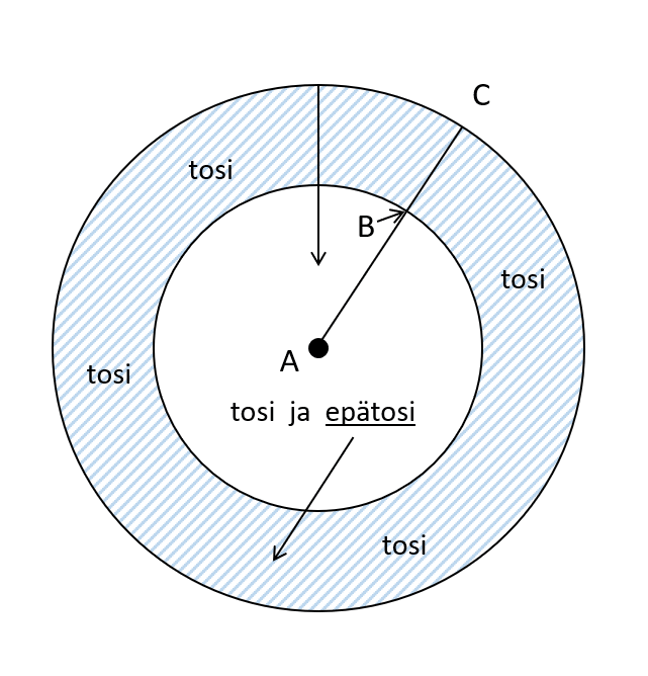
Image demonstrates the final result62, conclusion of applying correspondence theory to u-language in order to (make) well ordered language of said truth-theory. – CA is u-language as baseline of making well ordered language of correspondence theory. Second line is BA: Correspondence theory is applied to u-language CA, uppermost arrow from circle C. BA demonstrates the fact that the propositions* of the well ordere language of correspondence theory contain their* both truth- and falsehood-possibili-ties. BA is the point where said theory of truth seems to imply that it is invalid. The arrow from epätosi = false to BC, i.e. the third line of the image represents (the fact) that what seems a clear contradiction can be circumvent → falsehood can be substituted, replaced by truth. This – to circumvent is not me-rely a logical trick but a corollary of correspondence theory as a theory of metaphysical or ontological realism → a false proposition necessitates an ! o t h e r ! true proposition which represents that fact of reality a false proposition’s sense disagrees in order to be false. Wittgenstein considers this fact of cor-respondence theory by paragraphs 4.064 and 4.0641. – Thus to say BA + BC is not possible due to the law of contradiction and also by the law of identity (3.332 , 3.333) → (4.0312 , 4.128 , 6.4321) → Witt-genstein’s aim (Preface, (4.112 , 4.114)) fails.
It’s time to pull the (red) strings together, outline → to decipher the demonstration. That Wittgenstein’s aim (Preface, (4.112 , 4.114)) fails implies that there’s no BA63 / no ! circle B. There can’t be any limit to be drawn in u-language ”.. to the expression of thoughts ..” (Preface. (4.112 , 4.114))64. – An arrow from epä-tosi = false to BC deciphers circle B. In other words we are back in CA. However not in the same sense as baseline CA, i. e. u-language only as totality of grammatically correct propositions, declarative sen-tences. Consequently → in what kind of CA we are back? The whole domain of CA is now that of blue-white area of truths. What is false does not get lost, vanish. False propositions manifest their existence throughout relations between true propositions. The significance of this is that there are well ordered propositions of correspondence theory that rule out each other. Their truth preclude each other. Vica versa there are set of propositions that enable each other by their possible truth. – The world is com-posed (in every moment of its time and place) by sets of propositions that enable each other by their possible truth. – Thus that what Wittgenstein’s ”fundamental thought” (4.0312 , 4.128 , 6.4321) says in the context of sets of propositions that enable each other by their possible truth is that the totality of these sets is undecidable since if that totality could be decided it would entail sets of propositionsa that p r e c l u d e each other by their incompatible truth-values.65 – Indeed ! to contemplate ”.. the world sub specie aeterni is its contemplation as a limited whole ..” (6.45). Consequently ”.. the world .. as a limited whole ..” (6.45) precisely in that sense that the totality of sets of propositions that enable each other by their possible truth cannot be decoded66. – Recall (once again) that ”.. the whole logical space .. of facts ..” (1.1 + 1.2 + 3.42) is shown as a totality of well ordered propositions of corresponden-ce theory (4.06). – As for ”.. the mystical feeling .. that .. the world .. is” (6.44 + 6.45) that feeling origina-tes from the fact that although it’s inevitable by the logic of correspondence theory ”.. that .. the logic of facts cannot be represented”. (1.1 , 2.06 , 2.1 , 2.141 , 3.12 + 3.14 , 4.01 , 4.0312 , 4.06) it’s also so that ”.. the whole logical space .. of facts .. must already be given ..” (1.13 , 2.06 , 2.063 , 3.42 + 4.0312)67. – What is the ”.. whole logical space .. of facts .. already .. given ..” (3.42 + 4.0312)? – In my book it’s the whole do-main of CA → the blue-white area of truths. So ”.. the mystical feeling” (6.44 , 6.45) originates from the fact that (it’s enough) ! if you presuppose correspondence and its logic (to be valid) t h e n → the con-sistency of correspondence theory ! i m p l i e s → the existence of the possibility of true propositions* ! e v e n ! i f – and just because of – t h e y* ”.. cannot be said .. put into words ..” (4.1212 + 6.522) by any means of logic68. →
The logic of correspondence theory shows as a totality of well ordered propositions of correspondence theory made in u-language (1.13 , 2.0124 , 2.021 , 2.06 , 2.063 , 2.1 , 2.141 , 2,221 , 2,222 , 3.12 + 3.14 , 3.203 , 3.3 , 4.01 , 4.031 , 4.06 , 4.1 , 4.2) ”.. that.. the world is ..” (6.44 + 6.45) even if ! ”.. that .. the world is .. cannot be said .. put into words ..” (4.06 , 4.1212 + 6.44 + 6.45 + 6.552).
”Propositions cannot represent the logical form: this mirrors itself in the propositions. .. That which ex-presses itself itself in language we cannot express by language. The propositions show the logical form of reality. ..” (1.1 , 1.13 , 2.021* , 2.022 , 2.023 , 2.06 , 2.063 , 2.1 , 2.141 , 2.16 , 2.161 , 2.17 , 2.18 , 2.21 , 3.12 + 3.14 , 3.203* , 4.0312 , 4.06 , 4.12 , 4.121 , 4.1212 , 4.128 , 5 , 5.01* , 5.55* , 5.552 , 5.5571 , 5.6 , 6.4321 , 6.44 , 6.552)
Asterisks * in the context of some paragraphs indicate how easy it’s finally comprehend Wittgenstein’s substance-doctrine (which is perhaps the most difficult thing to grasp in (my interpretation of) Tracta-tus).
”.. Logic precedes every experience—that something is so. It is before the How, not before the What”. (1.1 , 1.13 , 2.021 , 2.022 , 2.023 , 2.06 , 2.063 , 2.1 , 2.141 , 2.16 , 2.161 , 2.17 , 2.18 , 2.21 , 3.12 + 3.14 , 3.203 , 4.0312 , 4.06 , 4.12 , 4.121 , 4.1212 , 4.128 , 5 , 5.01 , 5.55 , 5.55269 , 5.5571 , 5.6 , 6.4321 , 6.44 , 6.552)
”Not how the world is, is the mystical, but that it is”. (1.1 , 1.13 , 2.021 , 2.022 , 2.023 , 2.06 , 2.063 , 2.1 , 2.141 , 2.16 , 2.161 , 2.17 , 2.18 , 2.21 , 3.12 + 3.14 , 3.203 , 4.0312 , 4.06 , 4.12 , 4.121 , 4.1212 , 4.128 , 5 , 5.01 , 5.55 , 5.552 , 5.5571 , 5.6 , 6.4321 , 6.44 , 6.552)
Thus one can argue that logic and ”.. that .. the world is ..” (5.552 , 6.44 + 6.45) coincide is (a part of) ”the mystical” (6.44, look footnote 52.).
”There is indeed the inexpressible. This shows itself; it is the mystical”. (1.1 , 1.13 , 2.021 , 2.022 , 2.023 , 2.06 , 2.063 , 2.1 , 2.141 , 2.16 , 2.161 , 2.17 , 2.18 , 2.21 , 3.12 + 3.14 , 3.203 , 4.0312 , 4.06 , 4.12 , 4.121 , 4.1212 , 4.128 , 5.55 , 5.552 , 5.5571 , 5.6 , 6.4321 , 6.44 , 6.552)
As for the paragraphs 6.5 and 6.51 I think.. ! indeed – ”.. The riddle does not exist ..” (6.5 , 6.51) – in the context what said above. What Wittgenstein says in a roundabout way is that there can’t be any sen-sible scepticism70 of the existence of well ordered propositions of correspondence theory shown in u-language ”.. from within ..” (Preface, (1.1 , 1.13 , 2.0124 , 2.06 , 2.063 , 2.1 , 2.11 , 2.12 , 2.141 , 2.221 , 2.222 , 3 , 3.12 + 3.14 , 4 , 4.001 , 4.01 , 4.031 , 4.06 , 4.1 , 4.112 , 4.114)) which indicates the existence of the world.
One question remains. Is there any domain of CA, that area of blue-white area of truths? That is to say, ask –
Is there any circle of C either → is there any limit to be drawn to the well ordered propositions of correspondence theory – ”.. pictures of the reality” (4.06) – as they show themselves in CA ?
The answer is definitely not (any circle, limit C), simply because of the blue-white area of truths is de-vided to ! s e t s of – u n d e c i d a b l e – propositions which enable each others truths, and preclude others truths. – There cannot be (only) o n e ! single set of ! true propositions .. since.. IF so → f a l s e -h o o d would not be possible → throughout those other excluded (sets of) t r u t h s*, whose existence by them* representing propositions ”.. cannot be said” (4.1212).71
Therefore – what is left is (the center of the circle) → A.
In paragraph 5.64 Wittgenstein says –
”.. that solipsism strictly carried coincides with pure realism. The I in solipsism shrinks to an extension-less point and there remains the reality co-ordinated with it” (5.64).
That ”.. I .. point ..” (5.64) is that of A in my demonstration; with the one-of-a-kind (of set of) truths of ”.. my world .. and life ..” (5.621 + 5.63).
”The world and life are one”. (5.621)
”I am my world. (The microcosm.)”. (5.63)
But now the question is: Can I say those one-of-a-kind truths of mine? –The answer is no. It, to be ab-le to say my truths would necessitate me to say ! a l s o those ! o t h e r truths that make truths of mine possible. The point, essence of this is that I can say what paragraps 5.621 and 5.63 say.. i f f ! I presup-pose that other ! I’s – subjects independent of me – e x i s t → (5.64). – Above said is mutatis mutandis same as the result of Wittgenstein’s ”fundamental thought” (4.0312). From the point of view of ”.. The I .. the metaphysical subject ..” (5.64 + 5.641). – Thus as it is with ”.. the logic of the facts ..” (4.0312 , 4.1212 , 4.128 , 6.4321) the same applies (mutatis mutandis) in this context. i. e. ”.. in an important sense there is no subject: that is to say, of it alone in this book mention could not be made” (5.631) → we I’s are ! but that we are ”.. cannot be said” (4.1212).
Well then, consequently ”.. the reality co-ordinated with ..” (5.64) A is in a logical sense the world of well ordered propositions of correspondence theory made in u-language → made in my u-language. All the same the world as a totality of well ordered propositions of correspondence theory is undeci-dable in any u-language, in my u-language too. Thus exactly this undecidability of ”.. pictures of the reality” (4.06) determines –
”The limits of my language mean the limits of my world”. (5.6 , 5.61)
”Logic fills the world: the limits of the world are also its limits. We cannot therefore say in logic: This and this there is in the world, that there is not. For that would apparently presuppose hat we exclude certain possibilities, and this cannot be the case since otherwise logic must get outside the limits of the world: that is, if it could consider these limits from the other side also. What we cannot think, that we cannot think: we cannot therefore say what we cannot think.” (5.6 , 5.61).
The point (what I mean) is that ”.. the limits of .. my language ..” (5.6) is ! t h e r e i n.. that there actually exist no limit to be drawn to ”.. the expression of thoughts .. in language .. from within ..”. (Preface, (4.112 , 4.114)) by any I, by any subject – be it AI or any general method or algorithm of logic.
I see paragraphs 5.6 and 5.61 in the context of previous paragraph 5.5571. Thus in the context of Witt-genstein’s aim (Preface (4.112 , 4.114)) and ”fundamental thought” (4.0312) as an answer to the question implied in his aim. – But then by paragraphs 5.62 – 5.641 Tractatus goes I think ”.. outside the limits of the world ..” (5.61)72 to the problems of solipsism versus realism; and to the question of ”.. philosophi-cal I .. the metaphysical subject, the limit .. of the world” (5.641).
”The thinking, presenting subject; there is no such thing .. in an important sense there is no subject: that is to say, of it alone in this book mention could not be made”. (5.631)
In that sense ”.. solipsism is a truth ..” (5.62) that it is not possible draw a limit between I and the world and at the same time it’s a recommendation behalf realism. In my first reading of Tractatus there was another ! aha moment (besides that Gödel-idea with 4.0312) with paragraphs 5.633 and 5.6331. – Aha moment was that ! it ’s not possible to reduce that what is ”.. in the field of sight ..” (5.633) to one’s eye:
”.. from nothing in the field of sight can it be concluded that it is seen from an eye” (5.633 , 5.6331)
”For the field of sight has not a form like this: Eye ..” (5.633 , 5.633173)
I realise that what paragraphs 5.633 and 5.6331 say is that what is in ”.. the field of sight ..” (5.6331) of yours – of anyones – exist independently, i. e. it’s a recommendation behalf realism. Unless you talk big that ”.. the metaphysical subject ..” (5.641) of yours is everything, reach everywhere. Suppose you do not talk big – ”.. then what solipsism means .. cannot be said .. The I in solipsism shrinks to an ex-tensionless point and there remains the reality co-ordinated with it” ((5.62 + 5.64) → 7).
What is remaining? – When there are two things whom ”.. cannot be .. represented .. said ..” (4.0312 + 4.1212 + 5.62 , 5.632 , 5.641). The other ”.. the metaphysical subject .. that cannot be put into words ..” (5.641 + 6.522) is in any case ”.. co-ordinated with .. the reality ..” (5.64). What is reality, said in 5.64? Consequently with the main purpose of Tractatus (Preface, (4.112 , 4.114)) reality is the totality of well ordered propositions of correspondence theory shown in u–language by applying the logic of cor-respondence theory to that language. This totality is the other thing which ”.. cannot be .. represented .. said ..” (4.0312 + 4.1212 + 5.62 , 5.632 , 5.641 , 6.522). However totality of well ordered propositions* of correspondence theory (4.06) exist by the logic of said truth-theory even if and ! just because of they* cannot be enumerated (4.0312 , 4.128 , 6.4321).
S o – every ”.. I .. the metaphysical subject ..” (5.64 + 5.641) is ! c o-ordinated with ”.. the whole logical space .. of facts .. already .. given ..” (3.42 + 4,0312, italics is mine.) → the totality of possible truths is present → to get one by one (6.53) forever with no limit.
S o – i t ! is a choice74 of every ” .. I .. the metaphysical subject ..” (5.64 + 5.641) to make75.
References.
Those in Finnish are marked with *.
Tractatus Logico-Philosophicus → http://people.umass.edu/klement/tlp/tlp.pdf
Ludwig Wittgenstein: Tractatus locigo-philosophicus – Logisch-philosophische
Abhandlung, edition suhrkamp 12, Basil Blackwell, Oxford, 1959 .
*Ludwig Wittgenstein: Tractatus Logico-Philosophicus eli Loogis-filosofinen
tutkielma , 1984 Wsoy, also edition of year 1971.
*Georg Henrik von Wright: Logiikka, filosofia ja kieli , 1982 Otava .
*Tony Rosqvist: Gödel – aksiomaattisen aritmetiikan kaataja? (Arkhimedes
1 – 2 / 2014)
Torkel Franzén: Gödel’s Theorem – an incomplete Guide to its Use
and Abuse , 2005 by A K Peters Ltd. .
Lynn Gamwell: mathematics + art a cultural history , 2016 by Princeton
University Press .
*Apostolos Doksiadis & Khristos H. Papadimitriou, kuvitus Alekos Papadatos
ja Anne Di Donna: LOGICOMIX nerouden ja hulluuden rajalla, Suomenkielinen
laitos © Tua Korhonen & Avain 2010. – Original in English: Logicomix An
Epic Search for Truth © Logicomix Print Ltd. 2009.
Wikipedia contributions, look footnotes 21 , 22 , 26 and 36.
- Key-concept of correspondence theory is independence. It is the baseline of analysis of cor-respondence theory. Wittgenstein’s picture theory of language (2.022 , 2.16 , 2.161 , 2.17 , 2.18 , 4.06) is because of that concept. If (and when) the basic premise of correspondence theory is independence between language and reality then if not a (well ordered) proposition (of said theory of truth) has ”.. something in common .. with reality .. the logical form .. of reality” (2.16 + 2.17 + 2.18, italics is mine.) then it is not possible (even in principle) ”.. to compare .. its sense .. with reality” (2.222 + 2.223) in order to prove truth or falsehood of a proposition (2.21 , 2.221 , 2.222 , 4.031). Reason of (2.16 + 2.17 + 2.18) is that in the beginning – by independence – langu-age and reality are not in touch with each other, and so it is not possible to compare a propo-sition or ”.. its sense with reality ..” (2.222).
Thus the baseline of correspondence theory is that truth or falsehood of any proposition is not (yet) provable (which is in accordance with Russell’s paradox / look part C.). ↩︎ - Only with paragraphs 2.16 , 2.17 , 2.18 , 4.12 , 4.121 and 4.1212 you can see, that the totality of con-sistent propositions of correspondence theory that can be proved true or false is undecidable. That ”.. something in common .. with reality .. the logical form .. of reality .. cannot be said .. put into words ..” (2.16 + 2.18 + 4.12 + 4.121 + 4.1212 + 6.552) implies impossibility of enumerating the totality of propositions that can be proved true or false. ↩︎
- While the logic of correspondence theory and the (three) laws of thought preclude enumera-ting – to ”.. be put into words ..” (6.522) – well ordered propositions the consistency of same logic shows the necessary existence of these propositions. Correspondence theory, as a theo-ry of ontological realism, indicates existence of reality independent of (human) mind. Conse-quently the possibility of false propositions (2.21 , 2.221 , 2.222 , 4.031) entail that there e x i s t ”something” to disagree (in reality), i. e. ”something” that a sense of an other proposition can agree. That is to say the possibility of false propositions necessitates the existence of ! true propositions.
Yet this inevitability of the existence of ! true propositions ”.. cannot be said .. put into words ..” (4.1212 + 6.522). If could be said, it would derive invalid relation between true and false propo-sitions. It would violate paragraphs 2.061 and 2.062. ↩︎ - If we consider these paragraphs together side by side it is obvious that ”.. the facts .. in logical space ..” (1.13 + 4.0312) are propositions that ”.. can be true or false ..” (4.06). – The first point (meat of the matter) of Tractatus in the context of Russell’s paradox is so far only (if at all) the possibility of well ordered propositions, i. e. propositions that can be provably true or false. These propositions ! exist not yet → they must be done (2.1 → (1.13 , 2.0121 , 2.141 , 3.12 + 3.14 , 4.06 , 4.1 , 4.21 , 4.25 , 4.3 , 4.41 , 5 , 5.01)) ! with some theory of ”truth”, that is correspondence theory (2.21 , 2.221 , 2.222 , 2.223 , 4.031). The second point is to ask is it possible to ”.. draw a limit to .. the expression of ..” (Preface, italics is mine.) these propositions, i. e. ”thoughts” (Pre-face, (3 , 4 , 4.06)) ?
In my book second point means to express the totality of well ordered propositions – ”.. and what lies on the other side of the limit will be simply nonsense ..” (Preface ,(4.112 , 4.114)). This aim is obvious. If (we interpret) Russell’s paradox (so that it) contest the existence of valid, well ordered propositions of logic, then final step to revise that fact is ”.. to .. delimit .. the thinkable” (3 , 3.02 , 4 , 4.06 , 4.112 + 4.114, italics is mine.) → to express the totality of well ordered propo-sitions. ↩︎ - Our understanding of the world is not a random set of separate ”things”, i. e. not a separate set of ”.. a mixture of words ..” (3.141 , 3.142) but a totality of well ordered – ”.. significant .. propositi-ons ..” (3.142 , 4 + 4.001 , 4.06) made by ”meanings of names” (2.021 , 3.203 , 3.3) as correspon-dence theory imply (2.12 , 4.01 , 4.06). ↩︎
- Surprisingly, in my book ingeniously, Wittgenstein applies correspondence theory – its defi-nition – to define reality. Even if it is correspondence theory itself that necessitates to define reality. This applying is possible since it does not result in expressing any true or false propo-sitions of said theory of truth. – The question is as well only about possibility of true or false propositions of correspondence theory. ↩︎
- If anything was clear, comprehensible in my first reading of Tractatus it was interpretation of ”facts”; aha..something true or false. ↩︎
- Independence (4.061) is true also concerning ”facts” as ”pictures of the reality” (2.141 , 3.12 + 3.14 , 4.06). – It is so far only ”.. through the form of representation .. a picture of reality ..” (2.17 , 2.18 , 2.22 + 4.01) determines conditions of truth or falsehood. It is ”.. the logical form .. of reality .. the form of representation ..” (2.18 + 2.22) which ! not until makes the possibilities of truth or false-hood of the well ordered propositions of correspondence theory (2.12 , 4.01 , 4.06) → ”.. the lo-gical form .. of reality .. the form of representation ..” (2.18 + 2.22) ! precedes, is ”the substance .. of ..” (2.021 , 2.022 , 2.023 , 2.18 + 2,22 , 2.221* , 3.202 , 3.203 , 3.23 , 3.3 , 4.1 , ! 4.2* , 4.21 , 4.23 , 4.25 , 4.3 , 4.4 , 4.41 , 4.431 , 5 , 5.01) what makes .. pictures of the reality” (4.06). – In that regard ”.. propositions have a sense independent of .. pictures of the reality” ((1.12 , 1.13 , 2.024 , 2.141 , 3 , 3.12 + 3.14 , 4 , 4.06 + 4.061 , 4.1) → 4.2).
What paragraph 4.2 says ”.. is .. the inexpressible ..” (2.16 , 2.17 , 2.18 , 4.12 , 4.121 , 4.1212 , 6.522 , 7, italics is mine.). There is also ”.. the mystical” (6.44 , 6.522). Even if what 4.2 says ”.. cannot be said” (4.1212 , 6.522) every well ordered proposition ”.. contains the .. possibilities of existence and non-existence of states of affairs” (2.203 + 3.02 + 4.2 , 4.21 , 4.25 , 4.3 , 4.41 , 5 , 5.01). And the reason for that 4.2 is not possible is precisely (2.203 + 3.02 + 4.2 , 4.21 , 4.25 , 4.3 , 4.41 , 5 , 5.01) – To make 4.2 possible would necessitate a well ordered proposition to (be) contain(ed) in itself which would be a violation of laws of thought / logic (3.332 , 3.333). ”The mystical” is there that all truth-possibilities are within reach ! inside well ordered propositions (3.42)..but are yet ”.. inexpressible ..” (6.522). In the context of correspondence theory as a theory of ontological realism one can (really) say ”.. that .. the world is .. a limited whole ..” (6.44 + 6.45) ! i n s i d e (a valid) U-language .. but still ”.. cannot be said” (2.16 , 2.17 , 2.18 , 4.0312 , 4.12 , 4.121 , 4.1212 , 4.128 , 6.4321 , 6.522). ↩︎ - Hence by independence the first step of analysis of correspondence theory is simply that there are only all propositions of u-language and what they represent – ”.. such and such a state of affairs” (2.0124 , 2.021 , 3.203 , 4.031 , 4.0311). No one can yet point out a single proposition of u-language and assert it to be provable true or false (because of independence). ↩︎
- So – ”.. a picture of reality .. already .. contains .. the possibilities of the existence and non-exis-tence of states of affairs .. and it cannot contain itself ..” ((2.203 + 3.333 + 4.01 + 4.2) → 4.21 , 4.25 . 4.3 , 4.41 , 5 , 5.01, italics of 3.333 is mine.) ! anymore. ↩︎
- Correspondence theory is (in my book) not invalid – that what seems a clear contradiction can be circumvented – but it cannot be either proved consistent. Reason for that (unprovability) is precisely Wittgenstein’s ”Grundgedanke” (4.0312 , 4.128 , 6.4321) → totality of propositions that can be proved true or false is undecidable..which shows that correspondence theory is valid. Undecidability just by that well ordered propositions of correspondence theory cannot be con-tained themselves in order to decide their all truth-values. Only propositions contained them-selves would violate law of contradiction it would violate law of identity as well; propositions contained themselves cannot be equal (3.332 , 3.333). ↩︎
- Universal-language since Wittgenstein’s aim (Preface (4.112 , 4.114)) applies by correspondence theory (2.221 , 2.222 , 2.223 , 4.031) to ! every possible proposition that ”.. already .. represents such and such a state of affairs” (2.0121 , 2.0124 , 2.021 , 3.203 , 3.3 , 4.031 + 4.064 , 4.0311). ↩︎
- ”Objects” (2.021 , 3.202 , 3.203 , 3.3 , 4.23 , 5.55) are the subjects of that what is necessarily – there is no other space – contained in well ordered propositions of correspondence theory. ↩︎
- What ”.. agreement and disagreement with the possibilities of the existence and non-existence of states of affairs” (4.2 , 4.3 . 4.4 , 4.41 , 4.431 , 5 , 5.01) is all about later. That much already here that there are (of course) two different outcomes.
These outcomes must be consistent since well ordered propositions cannot contradict with that what they have to contain (2.022 , 2.06 , 2.1 , 2.11* , 2.16 , 2.161 , 2.17 , 2.18 , 2.201* , 2.202* , 2.203* , 3.02 , 3.13) in order to be well ordered. – Hence, there must be a way to ! circumvent (3.4 , 3.41 , 3.411 , 3.42 , 4.064 , ! 4.0641) that what seems to be a (clear) contradiction ↩︎ - We can make well ordered propositions of correspondence* theory applying it* to u-language but we cannot say these propositions. ↩︎
- In my book ”.. the logical form .. of reality (2.18) means ”.. the possibility of the .. existence and non-existence of states of affairs” (2.201 + 2.203 + 4.1), i. e. the possibility of truth and falsehood of the ”.. elementary propositions .. the truth-arguments of propositions” (4.1 , 4.2 , 4.21 , 4.25 , 4.3 , 4.41 , 5 , 5.01). ↩︎
- This is why Wittgenstein says ”.. that the ”logical constants” do not represent ..” (4.0312). ↩︎
- The provability of propositions must be premised on ”something”. ↩︎
- If there is no relation ”.. something in common .. with reality ..” (2.16 + 2.17 + 2.18) truth or false-hood of a proposition is still possible, but not provably since to ”.. compare .. its sense .. with reality ..” (2.221 + 2.222 + 2.223 , 4.031) is not (yet) possible. ↩︎
- As said there is not other place to necessary ”.. something in common .. with reality ..” (2.16 + 2.17 + 2.18 , 2.22) than inside ”.. pictures of the reality” (4.06) themselves. Independence prevails al-ready as the external relation between u-language and reality . ↩︎
- What paragraph 4.2 says is not possible if not ”.. possibilities of existence and non-existence of states of affairs” (4.2 , 4.21 , 4.25 , 5 , 5.01) are present – already contained to ”.. the propositional sign ..” (2.203 , 3.02 , 3.12 , 3.13 , 3.332 , 3.333) itself. ↩︎
- Recall that the challence is just to ”.. make to ourselves / propositions (that) can be true or false /”. (2.1 / (1.1 , 2.06 , 2.063 , 2.141 , 3.12 + 3.14 , 4.01 , 4.06)). Propositions in question are contingent propositions, which means that both truth-values, truth and falsehood, are possible. However truth must prevail; especially in the context of correspondence theory as a theory of (ontologi-cal or metaphysical) realism. ↩︎
- Do not dare to say even: ”The picture contains the possibility of .. the existence and non-exis-tence of states of affairs .. which it represents” ((2.06 , 2.1 , 2.201 + 2.203) → 4.1 , 4.21 , 4.25 , 4.3 , 4.41 , 5 , 5.01) without speaking of truth and falsehood.
In original german Tractatus this concern emerges more clearly in paragraphs 2.11 and 2.203. In both sentences Wittgenstein uses word ”die Sachlage”. In 2.11 its meaning is ”.. das Bestehen und Nichtbestehen von Sachverhalten ..” (2.11). Thus in paragraph 2.203 instead of saying ”.. die Mög-lichkeit der Sachlage..” it’s to say ”.. die Möglichkeit das Bestehen und Nichtbestehen von Sach-verhalten ..” (2.11 + 2.203, or is it to decline ”.. der Bestehen und Nichtbestehen von Sachverhal-ten ..”). ↩︎ - This encase the whole story of Tractatus when it’s about Wittgenstein’s picture theory of lan-guage. ↩︎
- It is precisely ”.. the simple .. names with different meanings ..” (3.23 + 5.55) that express the truth-possibilities of ”.. pictures of the reality” (4.06) and since ”.. the simple .. names with dif-ferent meanings .. cannot be said” (3.23 + 4.1212 + 5.55) Wittgenstein’s aim fails. ↩︎
- Here is a link to Wittgenstein’s ”mystical” (6.44 , 6.45 , 6.522). That ”.. the whole of logical space must already be given ..” (3.42) means that even if well ordered language as a whole contain the totality of possible facts of the world as they are shown in correctly formed language of corres-pondence theory these possible facts of the world ”.. cannot be said” (2.18 , 4.12 , 4.121 , 4.1212 , 6.44 , 6.45 , 6.522). Everything what is possible in the world is within reach, shown inside the correctly formed language of correspondence theory, but it’s not possible to decipher. It’s – ”.. a limited whole ..” (6.4321 , 6.44 , 6.45 , 6.522, italics is mine.).
Thus ”the possibility” said in paragraph 3.13 cannot be fulfilled → (3.332 , 3.333). What is said in paragraphs 4.2 , 4.4 , 4.431 cannot be fulfilled, i. e. ”.. a sense .. of a proposition ..” ((3.318 , 3.332 , 3.333) → 4 + 4.2 , 4.4 , 4.431) in its truth- and proof-theoretical meaning ”.. cannot be said .. put into words ..” (4.1212 + 6.552). To say it would necessitate that a proposition could be contained in itself which is not possible by the law of contradiction and the law of identity. – So ((4.0312 , 4.128 , 6.4321) → 7). ↩︎ - https://en.wikipedia.org/wiki/G%C3%B6del%27s_incompleteness_theorems ↩︎
- (https://en.wikipedia.org › wiki › R…) ↩︎
- The concept of ”truth” is accompanied by so called tree law of thought, i. e. the law of excluded middle, the law of noncontradiction and the law of identity. ↩︎
- https://en.wikipedia.org/wiki/Correspondence_theory_of_truth ↩︎
- More about independence in part E. ↩︎
- One can argue that Wittgenstein’s view is due to that it’s a proposition which not until as ”.. a picture of reality .. contains the possibility of the state of affairs which it represents” (2.203 + 4.01). I mean that hence a proposition do not directly justify the possibility of itself, and be a circular argument by containing its own possibility, but justifies ”.. the possibility of the state of affairs which it represents”. (2.203). ↩︎
- I interpret Wittgenstein’s substance-doctrine so that at first there exist only u-language. Its meaning with correspondence theory – which is the core of that doctrine – comes not until correspondence theory is applied to u-language. Yet It’s reasonable to say that correspondence theory is applied to u-language from the very beginning of Tractatus. ”Logical space” in para-graph 1.13 is that of correspondence theory’s. And relevant is what is contained* in well ordered propositions of correspondence theory. It* is present already in paragraph 2.014. ↩︎
- One can say that ”.. the possibilities of the existence and non-existence of states of affairs” (4.2) represents reality as it is expressed in u-language where the valid relation of u-language and reality has been shown, modelled. Recall that a language as a u-language can speak also of itself.
That what Wittgenstein says in paragraphs 3.332 and 3.333 is an implication of the valid rela-tion between u-language and reality – shown in u-language – as ”.. the possibilities of the exis-tence and non-existence of states of affairs” (4.2). ↩︎ - To say more straightforward / with the truth-possibilities, both true and falsehood, of its own / contained to ”.. a proposition ..” (4.2) itself. ↩︎
- If it could be realised then a true proposition which represents the possibility of a false propo-sition could be expressed. This would mean a possibility to express propositions that preclude, contradict each other. By the law of non-contradiction it is prohibited. ↩︎
- To exemplify this, you may imagine (some) ”x” and its box. A box which contains ”agreement and disagreement with plus and minus sign”. Let’s postulate that ”x” can also be contained in that box; it is evident that ”x” will ”agree and disagree with both plus and minus sign”. ↩︎
- ”Disagreement” would mean that ”.. the propositional sign ..” (3.332) in question agrees only with its truth- or falsehood-possibilities. In other words result would be solely either tauto-logies or contradictions (4.46). ↩︎
- These propositions, false and true* propositions which* make false propositions possible, are independent of each other; they cannot be said together. IF said together, THEN falsehood will be ! d e r i v e d ! from truth, or vice versa falsehood entails truth. ↩︎
- That a well ordered proposition ”.. already contains the prototype of its own argument ..” means (in my book) the same as that truth-possibilities, both true and falsehood, of truth-arguments (that) are contained to well ordered propositions, ”.. pictures of the reality” (2.06 , 2.11 , 2.201 , 2.202 , 2.203 , 3.02 , 4.06 , 4.3 , 4.41 , 5 , 5.01) themselves. ↩︎
- https://en.wikipedia.org/wiki/Axiom ↩︎
- That the core of Wittgenstein’s substance-doctrine is truth- and proof-theoretical emerges in paragraph 4.23: ”The name occurs in the proposition only in the context of the elementary pro-position” (4.23), i. e. ”.. only in the context of .. the truth-arguments of propositions (4.23 + 5.01). In my book this means that meanings of the (simple) names are expressions of truth-possibili-ties, both truth and falsehood, of ”.. truth-arguments of propositions” (3.23 , 4.2 , 4.23 , 4.3 , 4.4 , 4.41 , 4.431 , 5 , 5.01). Since these truth-possibilities ”.. cannot be said” (2.18 , 4.0312 , 4.12 , 4.121 , 4.1212 , 4.128 , 6.4321) it is as paragraphs (3.221 , 5.55 , 5.5571) say. – All ”.. facts in logical space ..” (1.13 , 2.06 , 2.1 , 2.11 , 2.141 , 2.201 , 3.12 + 3.14 , 4.06) of correspondence theory ”.. cannot be put into words ..” (3.4 , 3.41 , 3.411 , 3.42 , 4.0641 , 4.1212 , 4.128 , 6.552, italics is mine.) even if they are as if wired to exist ((1.13 , 2.06 , 2.1 , 2.11 , 2.201 , 2.202 , 2.203 , 3.02 , 4.1 , 4.21 , 4.25 , 4.3 , 4.41 , 5 , 5.01) → 6.44). ↩︎
- Here ”.. a proposition with a sense” (4) is that of well ordered proposition of correspondence theory. ↩︎
- This is the essence of independence between u-language and reality (2.024 , 4.061).
That it is as paragraph 4.064 says also in the meaning of paragraph 4.2 derives from that in well ordered propositions ”.. the logical form .. of reality .. the form of representation .. is .. already .. contained” (2.17 , 2.18 + 2.22 + 3.13 + 3.333). Thus in well ordered propositions are already con-tained the ”.. possibilities of existence and non-existence of states of affairs” (4.2). – Recall, that ”.. the logical form .. of reality .. possibilities of existence and non-existence of states of affairs” (2.022 , 2.06 , 2.063 , 2.16 , 2.161 , 2.17 , 2.18 + 4.2) is equivalent with the truth-possibilities, both true and false, of ”.. the truth-arguments of propositions” (4.2 , 4.25 , 4.3 , 4.41 , 5 , 5.01). – So, I think, also the ”.. agreement and disagreement with the possibilities of the existence and non-existence of states of affairs” (4.2 , 4.25 , 4.3 , 4.41 , 5 , 5.01) is as if wired to come true. Anyway ”.. the whole logical space .. already .. given ..” (3.42) to come true ”.. cannot be said” (4.1212). – This is I think Wittgenstein’s ”mystical” (6.44 , 6.45 , 6.522) → every possible well ordered propositi-on is already wired to be present in valid u-language of correspondence theory b u t ! ”.. as a limited whole ..” (6.45) that u-language is ”.. i n e x p r e s s i b l e ..” ((6.552) → 7). ↩︎ - Perhaps it is worth of mention the meanings of a ”substance” as a concept. One is that it’s not possible to present or deny the existence of a substance without even as applying that subs-tance; a substance is always already-present (also in saying yes or denying a substance). Inde-pendence is another necessary quality of a substance. If a substance of ”something” is not inde-pendent of that ”something”, a substance can be deduced from that ”something”; it would be to end up to circular argument. ↩︎
- That reality can be deternimed in u-language (which is requirement) in order to show well or-dered propositions of correspondence theory is due to indedence. ↩︎
- Cf. for example a potters clay as long as its composition is correct. As such all grammatically correct propositions of u-language are (only) the ”clay” of that ”.. Logic treats of every possibility and all possibilities are its facts ..” (2.0121). This is said also in paragraphs 5.473 , 5.4731 , 5.4732 , 5.4733 and 5.5563. Although those paragraphs have also the profound meaning of ”.. a sense” (4), that of truth and provability (4.1 , 4.2 , 4.21 , 4.25 , 4.3 , 4.4 , 4.41 , 4.431 , 5 , 5.01). ↩︎
- Since it is these truth-possibilities which ! make ”.. pictures of the reality” (4.06), their all truth-values (4.46 , 4.464), one can argue that truth-possibilities of ”.. the truth-arguments of proposi-tions” (4.21 , 4.23 , 4.25 , 4.3 , 4.41 , 5 , 5.01) contained in ”.. pictures of the reality” (4.06) are inde-pendent of propositions (4.06) which they make. – Indeed said independence prevails. It is just what Wittgenstein’s ”fundamental thought” (4.0312 , 4.128 , 6.4321) says: It’s impossible to show truth-possibilities of ”.. the truth-arguments of propositions” (4.06 , 5.01) and propositions (4.06) together, in the same context (3.332 , 3.333 , 4.064 , 4.0641). For this reason ”.. the expression of .. truth-conditions .. contained in .. pictures of the reality”. (3.318 + 4.06 + 4.431) can’t be done → to express ”.. a sense .. of a proposition ..” ((3.318 , 3.332 . 3.333) → 4 + 4.2 , 4.21 , 4.25 , 4.3 , 4.4 , 4.41 , 4.431 , 4.46 , 4.464) is not possible. ↩︎
- Analysis of correspondence theory necessitate to define ”reality”. If that definition could not be done by applying said truth-theory itself then definition would be (more or less) arbitrary. ↩︎
- Is it possible to express, enumerate all ”.. pictures of the reality” (2.022 , 2.16 , 2.161 , 2.17 , 2.18 , 2.2 , 2.22 , 3.13 , 4.06)? That is all the well-formed, provably true or false, propositions of cor-respondence theory? ↩︎
- ”False propositions” as true ”negative propositions” like for example (it’s true that) ”Finland is not hot and dry sand-desert like Sahara”. Instead (it’s true that) ”Finland is a country with thousands of lakes and plenty of woods” which ”.. determines .. that is not the case” (1.12) → said true ”ne-gative proposition”. ↩︎
- At least in my book to postulate ”something” do not yet make that ”something” to exist. For ins-tance to postulate ”a round cow”. At best to postulate ”something” is a necessary means to do what is intended to do as in the case of Wittgenstein’s aim. ↩︎
- ”Facts” are ”in logical space” of the correspondence theory. As for independence with respect to ”.. pictures of the reality” (4.06) look footnote 32. ↩︎
- Necessary to consistency of correspondence theory. ↩︎
- Go without saying how ! complex Tractatus is. A benefit of the book is the composition; para-graphs are easy to refer (once having some grasp of the book). ↩︎
- To bring together Wittgenstein’s ”fundamental thought” (4.0312) and Gödel’s theorem’s – mainly the first – is likely when one considers that ”facts” have something to do with ”truths”.
To evade misunderstanding G. H. von Wright does not propose relation between Tractatus / (4.0312 , 4.128 , 6.4321) and Gödel’s theorem’s. That idea just occured (when reading 4.0312). ↩︎ - This is similar with the worse case if independence prevails not (look at end of part E.). – In the context of picture theory ”.. the logical form .. of reality” ((2.16 , 2.17 , 2.18 , 2.2) → 2.06 , 2.1 , 2.11 , 2.201 , 2.202 , 2.203 , 3.02 , 4.06 , 4.1 , 4.21 , 4.25 , 4.3 , 4.41 , 5 , 5.01) represents reality. Hence it’s the ”.. agreement .. with the possibilities of the existence and non-existence of states of affairs” (4.2) which derives a contradiction. ↩︎
- Thus breaking the law of identity and breaking the law of contradiction clap hands: A propositi-on* would agree with an ! other proposition (3.332 , 3.333) which by its truth makes the false-hood of the first propositon* possible. – This ”clap hands” is (perhaps) what Wittgenstein deno-tes in paragraph 4.062. ↩︎
- Paragraphs 4.112 and 4.114 are not yet with since I am in the beginning of the first reading. ↩︎
- And when I say ”know” I mean that it (2.06 , 2.1 , 3 , 4 , 4.01 , 4.06) is a (positive) fact of Tracta-tus; not an interpretation. ↩︎
- As for to ”.. draw a limit .. to the expression of / propositions that can be true or false /” look part B.. ↩︎
- Except that – in the very end – to decipher d-image. ↩︎
- Thus that what seems to imply that correspondence theory is invalid prevails not anymore. ↩︎
- ”Thoughts” / 2.06 , 2.1 , 3 , 4 , 4.01 and 4.06. ↩︎
- It is in principle impossible to decide the totality of sets of each other enabling and ! precluding propositions. ↩︎
- Since that totality would entail propositions which preclude each other by their incompatible truth-values. ↩︎
- That it is as (2.06 , 2.1 , 2.141 , 3.12 + 3.14 , 3.42 + 4.0312 , 4.06) says is derived ! just from the fact that truth-values of well ordered propositions of correspondence theory, i. e. ”.. pictures of the reality” (4.06) actualise throughout relations between these propositions (4.064 , 4.0641 , 4.125) → to be consistent ”.. pictures of the reality” (2.06 , 2.1 , 2.141 , 3 , 3.12 + 3.14 , 4 , 4.01 , 4.06) n e – c e s s i t a t e ! (the existence) of each other. – Hence, that the totality of ”.. pictures of the rea-lity .. cannot be said” (2.18 , 4.06 + 4.1212 , 4.128 , 6.522) denotes that the consistency of corres-pondence theory cannot be proved. Anyway precisely that (4.0312 , 4.06 + 4.1212 , 4.128 , 6.4321 , 6.522) s h o w s ! that correspondence theory is consistent. – I think that (4.0312 , 4.06 + 4.1212 , 4.128 , 6.4321 , 6.522) is more important criterion (although implied). ↩︎
- This (4.1212 + 6.522) is also consistent with the fact – or postulate – that correspondence theory is a theory of metaphysical, ontological realism. If Wittgenstein’s ”fundamental thought” (4.0312) prevails not, i. e. ”the logical forms” (2.17 , 2.18 , 2.21 , 4.12 , 4.12 , 4.121 , 4.1212 , 4.128 , 6.522) could be enumerated then it would be a sort of solipsism → reality could be represended in language ”.. from within ..” (Preface, (4.112 , 4.114)). ↩︎
- Next paragraph 5.5521 is in my book as if a Koan*. – (You may look Its* meaning by google.) ↩︎
- If could it would refute the whole language; its valid relation to the world. ↩︎
- This is consistent with paragraphs 1.2 , 1.21 , 2.061 and 2.062 since sets of true propositions are independent of – they preclude (as well) – each others. To infer each others is not possible. ↩︎
- This is not a reproof, but part of Wittgenstein’s if not self-contradictory yet paradoxical thinking. For example to be able to say his famous last paragraph 7 Wittgenstein has to express ”Where-of .. one must be silent” (7, italics is mine.). ↩︎
- Open Tractatus at this point: You see a drawing of a closed space. ↩︎
- Be it free or not. ↩︎
- Logic and Ethics are together. ↩︎
 Wittgenstein's ladder - Wittgensteinin tikkaat